All-on-4 vs All-on-6 Dental Implants
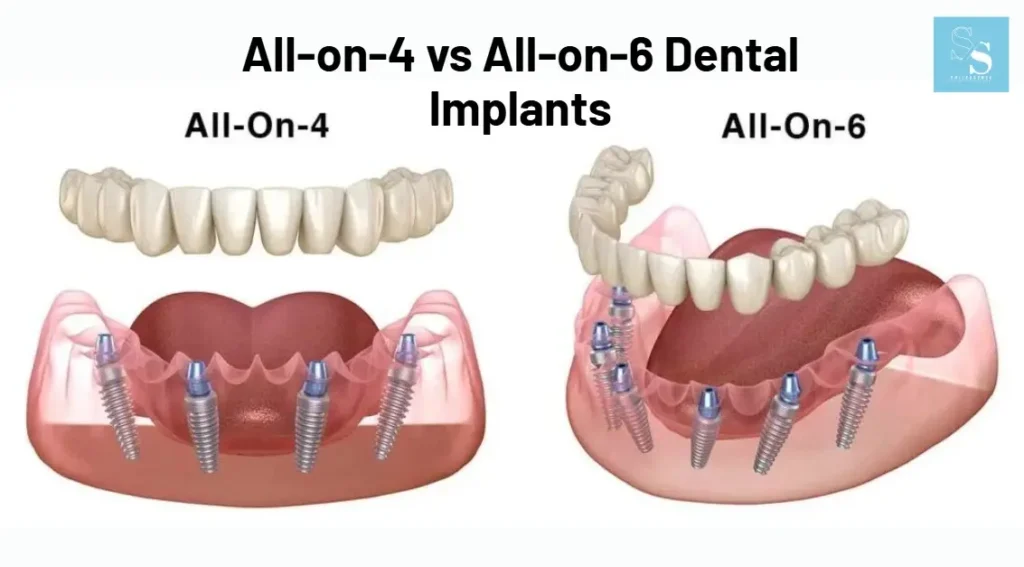
All-on-4 vs All-on-6 Dental Implants – Which Full-Mouth Solution is Right for You?
If you have been told you need a full-mouth restoration, or if you have been living with multiple missing teeth, failing teeth, or uncomfortable dentures for some time, you have likely come across two treatment names: All-on-4 and All-on-6. Both are full-arch dental implant solutions. Both can give you a complete set of permanent, natural-looking teeth. And both are available at Smilessence – The Specialist Dental Centre in Palam Vihar, Gurgaon.
But they are not the same treatment, and choosing the right one depends on your bone structure, your specific dental condition, and your long-term goals. This guide gives you a clear, honest comparison of both options so you can walk into your consultation already informed.
What is All-on-4?
All-on-4 is a full-arch dental implant technique where four implants are strategically placed into the jawbone to support a complete set of fixed upper or lower teeth. The two rear implants are placed at an angle – typically 30 to 45 degrees – which allows them to anchor into denser bone at the front of the jaw without needing bone at the back.
This angled placement is the defining innovation of the All-on-4 technique. It means that patients who have experienced bone loss at the back of the jaw, which is extremely common after tooth loss, can often receive a full arch of implants without requiring a bone graft first. In many cases, a temporary set of functional teeth can be fitted on the same day as surgery, which is why the treatment is sometimes called ‘teeth in a day’. Healthy teeth need a healthy foundation. Don’t let gum disease lead to tooth loss.
Key facts about All-on-4
- 4 implants support a full upper or lower arch
- Rear implants placed at an angle to maximise contact with available bone
- Suitable for patients with moderate bone loss – often eliminates the need for bone grafting
- Same-day temporary teeth are possible in many cases
- Shorter overall treatment timeline than traditional implant methods
- Lower implant count means slightly lower cost than All-on-6
What is All-on-6?
All-on-6 follows the same principle as All-on-4 – a full arch of permanent teeth supported by implants – but uses six implants instead of four. The additional two implants are positioned to distribute biting force more evenly across the entire arch, providing greater overall stability, particularly for the upper jaw, where bone density is naturally lower.
All-on-6 is generally recommended for patients who have sufficient bone volume to accommodate six implants, or for those who want the maximum level of stability and load distribution possible. The upper arch in particular benefits significantly from six implants due to the anatomy of the upper jaw, which tends to have softer, less dense bone than the lower jaw. Experience faster, friction-free alignment with self-ligating ceramic braces.
Key facts about All-on-6
- 6 implants support a full upper or lower arch
- Greater biting force distribution – especially beneficial for the upper jaw
- More stable and durable over the long term due to additional support points
- Recommended for patients with sufficient bone who want maximum long-term stability
- Ideal for patients with heavier bite forces or parafunctional habits like grinding
- Slightly higher cost than All-on-4 due to additional implants
All-on-4 vs All-on-6 – Side-by-Side Comparison
| Factor | All-on-4 | All-on-6 |
| Number of implants | 4 implants per arch | 6 implants per arch |
| Bone requirement | Lower – works with moderate bone loss | Higher – needs sufficient bone volume |
| Bone graft needed? | Usually not required | Rarely required; depends on individual case |
| Same-day teeth? | Yes – common in most cases | Yes – in most cases |
| Stability level | Excellent – sufficient for most patients | Maximum – ideal for upper arch or heavy bite |
| Best for upper jaw? | Good | Excellent – especially recommended |
| Best for lower jaw? | Excellent | Very good |
| Treatment timeline | 3–6 months total | 3–6 months total |
| Cost at Smilessence | ₹2,50,000 – ₹4,00,000 per arch | ₹3,50,000 – ₹5,50,000 per arch |
| Ideal patient profile | Bone loss, wants a cost-effective solution | Good bone volume, wants maximum stability |
Who Should Choose All-on-4?
All-on-4 is typically the recommended option for patients who:
- Have experienced significant bone loss in the jaw – particularly at the back – and want to avoid bone grafting
- Have been wearing dentures for several years and have noticed changes in their facial structure
- Want to restore a full arch of teeth in the shortest possible timeline
- Are on a defined budget and want the most cost-effective full-arch implant solution
- Are restoring the lower jaw, where All-on-4 performs especially well
- Have been told by a previous dentist that they are ‘not suitable for implants’ due to bone loss – All-on-4 may still be possible
Who Should Choose All-on-6?
All-on-6 is typically recommended for patients who:
- Are restoring the upper jaw, which has naturally softer bone that benefits greatly from the additional support of six implants
- Have good overall bone volume and density, making it feasible to place six implants comfortably
- Have a heavier bite or a history of teeth grinding (bruxism), where the extra implants help absorb greater force
- Are restoring both upper and lower arches and want consistent, maximum stability across both
- Are you a younger patient wanting the most durable long-term solution
- Have already undergone a bone graft to increase bone volume and can now support six implants
The Treatment Process – What to Expect for Both Options
Whether you choose All-on-4 or All-on-6, the treatment process at Smilessence follows the same careful, specialist-led steps:
- Consultation & 3D Imaging– Prof. Dr Vinayak examines your mouth and jaw using our in-house 3Shape scanner and 3D digital X-rays. This creates a precise map of your bone density, nerve positions, and anatomy. The right treatment is recommended based on your specific data – not a one-size-fits-all approach.
- Treatment Planning– A fully customised treatment plan is prepared, including the positioning of each implant, the design of your prosthesis, and the anticipated timeline.
- Implant Surgery– All implants are placed in a single surgical session under local anaesthesia. The procedure typically takes 2–4 hours per arch. Most patients report being surprised by how comfortable the experience is.
- Same-Day Temporary Prosthesis– In most cases, a temporary fixed set of teeth is attached to the implants on the same day. You leave with functional, natural-looking teeth – not an empty mouth.
- Osseointegration Period (6–12 Weeks)– The implants fuse with your jawbone over the following weeks. During this period, you return home and follow a soft-food diet. The implants are integrating silently beneath the surface.
- Final Prosthesis Fitting– Once osseointegration is confirmed, your permanent prosthesis – crafted to match the exact shade and shape of natural teeth – is fitted and adjusted to your bite. This is your long-term, final result.
Can You Really Get Teeth in a Day?
Yes- in most All-on-4 and All-on-6 cases, a temporary fixed prosthesis is attached on the same day as implant surgery. This is not a removable denture. It is a fixed, functional set of teeth that you can eat and speak with immediately.
The temporary prosthesis is replaced with the final permanent prosthesis after the osseointegration period is complete – typically 12–16 weeks after surgery. The final prosthesis is crafted from high-grade materials to your exact specifications and is designed to last many years with proper care. Don’t ignore that sharp toothache—learn how a root canal treatment can save your natural tooth.
It is important to note that ‘teeth in a day’ does not mean the entire treatment is complete in one day. The implant surgery and temporary fitting happen in one day. The full, permanent restoration is completed after the healing period. Patients who understand this have consistently higher satisfaction with their outcomes.
What if I Have Been Told I Need a Bone Graft?
Bone loss is one of the most common reasons patients are told they are ‘not suitable for implants’. The All-on-4 technique was specifically designed to work around this problem – by using longer, angled implants that anchor into the denser bone at the front of the jaw.
In many cases where a conventional implant approach would require bone grafting, All-on-4 makes the treatment possible without a graft. This significantly reduces the overall treatment cost, eliminates one surgical procedure, and shortens the timeline considerably.
However, every patient is different. Some cases of severe bone loss may still require grafting before either option is feasible. A 3D CT scan assessment is the only way to know for certain what your specific jaw can accommodate. At Smilessence, this assessment is part of your initial consultation.
How Long Do All-on-4 and All-on-6 Implants Last?
Both All-on-4 and All-on-6 implants are designed to be permanent solutions. With proper care- regular brushing, flossing around the prosthesis, and routine dental check-ups – the implant posts themselves can last a lifetime. The prosthesis (the visible teeth) may need replacement or refurbishment after 10–20 years due to natural wear.
Studies tracking All-on-4 patients over 10 years show implant survival rates of 94–98%. All-on-6 has comparable data with some evidence of even higher long-term prosthesis survival due to the additional support. Why pay 5X more abroad? Discover how dental implants in India compare with the USA & UK.
At Smilessence, every full-arch implant procedure comes with a lifetime warranty on the implants themselves with proper care – one of very few clinics in India to offer this commitment.
FAQ’s About All-on-4 vs All-on-6 Implant
Q1. Is All-on-4 or All-on-6 more painful?
Neither procedure is considered particularly painful. Both are carried out under local anaesthesia, and patients typically experience mild soreness for 2–4 days after surgery, which is managed comfortably with standard pain relief. Most patients return to light daily activities within 24–48 hours.
Q2. Can I get All-on-4 on both upper and lower jaws at the same time?
Yes, it is possible to treat both arches in the same surgical session, though this depends on your overall health and the complexity of your case. Many patients choose to treat both arches simultaneously to reduce total recovery time and the number of procedures. Dr. Vinayak will advise based on your specific situation during the consultation.
Q3. How do I clean and maintain All-on-4 or All-on-6 teeth?
The fixed prosthesis is cleaned similarly to natural teeth – with a soft-bristled toothbrush, low-abrasive toothpaste, and a water flosser or interdental brush to clean under and around the prosthesis. Unlike removable dentures, there is no need to take them out at night. A professional clean at your dental clinic every 6–12 months is recommended.
Q4. What foods can I eat after All-on-4 or All-on-6 surgery?
During the first 6–8 weeks after surgery (the osseointegration period), a soft diet is recommended – soup, yoghurt, mashed vegetables, soft fish, and eggs. Once the implants have fully integrated and the final prosthesis is fitted, you can eat virtually anything you would eat with natural teeth, including crunchy vegetables, bread, and most meats.
Q5. What is the difference in cost between All-on-4 and All-on-6 in Gurgaon?
At Smilessence, All-on-4 per arch starts from approximately ₹2,50,000 and All-on-6 per arch from approximately ₹3,50,000. The exact cost depends on your bone condition, the implant brand used, and the prosthesis material. For full cost details and to get a personalised estimate, visit our dental implants treatment page or contact us directly.
Q6. Am I a candidate for All-on-4 or All-on-6 if I currently wear dentures?
Yes – in fact, patients who have been wearing dentures for a long time are among the most common candidates for full-arch implant treatment. Long-term denture use often leads to jawbone loss, which makes All-on-4 particularly relevant since it is designed to work with reduced bone. A 3D imaging assessment will confirm exactly what is possible in your specific case.
Q7. How do I know which option is right for me?
The only reliable way to determine whether All-on-4 or All-on-6 is the right choice for you is a proper clinical assessment – including a 3D CT scan to measure bone volume, density, and anatomy. No website, no article, and no video can substitute for this. What this guide can do is make sure you walk into that consultation already understanding the difference, so you can ask the right questions and make a confident, informed decision.
Conclusion
Both All-on-4 and All-on-6 are excellent, proven, permanent solutions for full-arch tooth replacement. The right choice depends on your bone structure, which arch is being treated, your bite, and your long-term goals – not on a preference for one number over another.
What matters most is that you choose a specialist implantologist who will assess your specific anatomy thoroughly, use premium implant systems, and plan your treatment with precision. At Smilessence, Prof. Dr. Vineet Vinayak does exactly this – with 22+ years of experience, in-house 3D imaging, and a team of dedicated specialists who treat full-arch restoration cases every week.
Whether you need All-on-4, All-on-6, or a different implant-based solution entirely, the right starting point is a thorough consultation. Everything else follows from there.
| Not Sure Which Option is Right for You?
Book a consultation with Prof. Dr. Vineet Vinayak at Smilessence. He will assess your bone structure, gum health, and bite – and recommend the right full-arch solution for your specific case. 📞 +91 9811 303 933 | +91 9811 334 633 📍 SFF/102, Ansal Palam Triangle, Palam Vihar, Gurgaon – 122017 |