
Dental Implants vs Dentures vs Bridge
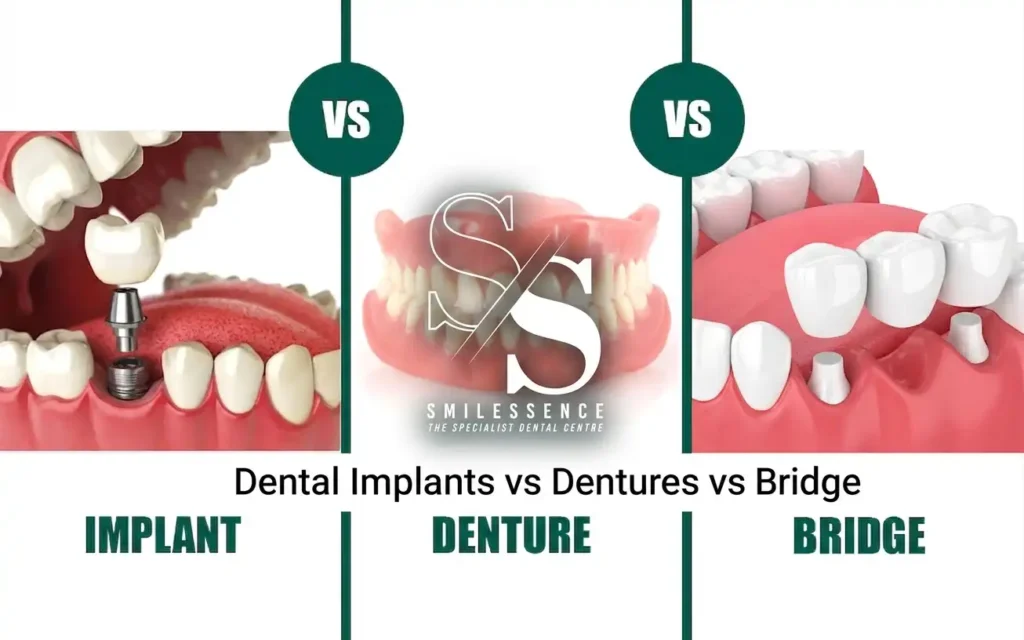
Dental Implants vs Dentures vs Bridge — Which is Best for Missing Teeth?
When a tooth is lost — whether through decay, injury, gum disease, or extraction — the question every patient faces is the same: what do I replace it with? Three options are available in modern dentistry: dental implants, a dental bridge, or dentures. Each has its place. Each has its trade-offs. And the right answer depends on your specific situation — not on what someone else chose.
This guide gives you a clear, honest comparison of all three options across every factor that matters: cost, longevity, comfort, oral health impact, and long-term value. By the end, you will understand not just what each option is, but which one is most likely right for you: experience faster, friction-free alignment with self-ligating ceramic braces.
Understand What Each Option Actually Is-
1. Dental Implants
A dental implant is a titanium or zirconia post surgically placed into the jawbone, acting as an artificial tooth root. Once it fuses with the bone (osseointegration), a custom crown, bridge, or full prosthesis is attached on top. The result looks, feels, and functions like a natural tooth — with no impact on neighbouring teeth and no removal required for cleaning. Not all implants take months. Find out who can get same day dental implant treatment.”
2. Dental Bridge
A dental bridge replaces one or more missing teeth by anchoring a false tooth (pontic) to the natural teeth on either side of the gap. The adjacent teeth — called abutment teeth — are filed down and crowned to hold the bridge in place. A bridge is fixed and cannot be removed, but it does not involve surgery and is typically faster and less costly upfront than implants.
3. Dentures
Dentures are removable prosthetic teeth — either partial (replacing some teeth) or full (replacing an entire arch). They sit on top of the gum and are held in place by suction, adhesive, or clasps on remaining teeth. Dentures are the most affordable upfront option but require daily removal for cleaning and can feel less stable than fixed solutions. Don’t ignore that sharp toothache—learn how a root canal treatment can save your natural tooth.
Full Comparison: Implants vs Bridge vs Dentures
| Factor | Dental Implants | Dental Bridge | Dentures |
| Longevity | Lifetime (with care) | 10–15 years | 5–10 years |
| Looks natural | Virtually identical | Very good | Good, but can look artificial |
| Feels natural | Yes — fixed in jaw | Yes — fixed in the mouth | Can slip, click or feel loose |
| Jawbone preservation | Yes — stimulates bone | No bone loss continues | No — accelerates bone loss |
| Impact on other teeth | None — stands alone | Requires grinding 2 teeth | May stress adjacent teeth |
| Eating ability | Unrestricted (after healing) | Mostly normal | Some restrictions always |
| Cleaning | Brush & floss normally | Special flossing required | Remove daily for cleaning |
| Surgery required | Yes | No | No |
| Upfront cost (India) | ₹25,000–₹45,000/tooth | ₹15,000–₹35,000/unit | ₹8,000–₹25,000/arch |
| Long-term cost | Lowest — lasts a lifetime | Higher — replacement needed | Highest — frequent repair/replace |
| Bone graft sometimes? | Yes, if bone lost | No | No |
| Suitable for all ages? | 18+ (adults only) | Most adults | All ages including the elderly |
| Overall rating | Best long-term solution | Good medium-term fix | Most accessible option |
Dental Implants — The Long-Term Gold Standard
Dental implants are the only tooth replacement option that addresses the root of the problem — literally. When a tooth is lost, the jawbone beneath it begins to deteriorate because it no longer receives the stimulation it needs. A bridge or denture replaces the visible tooth but does nothing for the bone below. An implant replaces the root, stimulates the bone, and prevents this deterioration entirely.
Over a lifetime, this biological advantage becomes the defining factor. Implants do not need to be replaced every 10–15 years like bridges. They do not loosen, slip, or require adhesive like dentures. They do not require grinding down perfectly healthy neighbouring teeth. And they allow you to eat, speak, and smile exactly as you would with natural teeth. Why pay 5X more abroad? Discover how dental implants in India compare with the USA & UK.
Where implants are the clear choice
- Single missing tooth — especially when adjacent teeth are healthy and should not be touched
- Multiple missing teeth in different parts of the mouth
- Patients who want a permanent, lifetime solution with no ongoing maintenance costs
- Patients who are tired of dentures and want something fixed and stable
- Full-arch restoration — using All on 4 or All on 6 dental implants technique, a complete set of teeth can be supported on just 4 or 6 implants
Where implants need more thought
- Patients with significant bone loss may need a bone graft first, adding cost and time
- Patients with uncontrolled systemic conditions (uncontrolled diabetes, active cancer treatment) may need to delay treatment
- Patients with a very tight upfront budget, though the long-term cost is the lowest of all three options
Dental Bridge — A Good Medium-Term Solution
A dental bridge is a well-established, effective option — particularly for patients who need a faster, less invasive solution and do not mind the trade-offs. The procedure does not involve surgery, the results are immediate, and the cost is lower upfront than implants.
The key limitation is the impact on adjacent teeth. To place a bridge, the two healthy teeth on either side of the gap must be permanently ground down and crowned. These teeth are healthy — they have not been damaged — but they are being altered irreversibly to support the bridge. If the bridge eventually fails, those teeth may also be compromised. For this reason, many specialist dentists view a bridge as a trade-off: solving one problem by potentially creating the conditions for two more. Healthy teeth need a healthy foundation. Don’t let gum disease lead to tooth loss.
The second limitation is bone loss. A bridge spans the gap but does not stimulate the bone beneath the missing tooth. Over years, the bone in that area gradually resorbs. This can cause a visible dip in the gum line under the bridge, making it look less natural over time — and making future implant placement more complex if the bridge eventually needs replacement. Confused about dental implant procedures in India? This guide simplifies it for NRI dental implant in India.
Where a bridge is a reasonable choice
- Patients who are not suitable for implant surgery due to medical reasons
- Patients who cannot afford implants and need a fixed (non-removable) solution
- Short gaps of 1–2 teeth where the adjacent teeth already have crowns or significant restorations
- Patients who want a quicker solution — a bridge can typically be completed in 2–3 visits
Dentures — The Most Accessible Option
Dentures remain the most widely used tooth replacement option in India and globally — primarily because they are the most affordable upfront and do not require surgery. For patients who have lost most or all of their teeth, full dentures provide a functional and cosmetically acceptable result when other options are not feasible. Get a confident smile with a solution that’s proven, powerful, and affordable—why metal braces are great choice explained.
However, dentures come with a set of well-known limitations that accumulate over time. They rest on the gum, not in the bone, which means they accelerate bone resorption rather than preventing it. As the bone shrinks, the fit of the denture changes, leading to looseness, slipping, and the need for frequent relining or replacement. The average denture needs adjustment or replacement every 5–8 years.
Eating with dentures also has real limitations. Hard, crunchy, or sticky foods are difficult to manage, and patients often unconsciously restrict their diet over time. Many long-term denture wearers report that implant-supported dentures — where implants anchor the denture in place — transformed their quality of life. If the budget allows, this hybrid solution offers much of the stability of implants with a lower cost than a full fixed restoration. For full cost details and to get a personalised estimate, visit our dental implants treatment page or contact us directly.
Where dentures are the appropriate choice
- Patients for whom surgery is medically contraindicated
- Elderly patients with limited bone volume where implant surgery is not advisable
- Patients who need an immediate, low-cost solution while planning a more permanent option later
- Full-arch tooth loss where implants are not currently affordable — with the option of converting to implant-supported dentures in the future
Specific Scenarios: Which Option Wins?
Rather than abstract comparisons, here is what each option looks like in the most common real-world situations:
| Situation | Recommended | Why |
| Single missing tooth, adjacent teeth are healthy | Implant | Preserves neighbouring teeth. No grinding. Permanent solution. |
| Single missing tooth, adjacent teeth already crowned | Bridge or Implant | Bridge is reasonable since the abutments are already restored. Implant is still preferred long-term. |
| Multiple missing teeth, different positions | Implants | A bridge spanning multiple gaps is large and unstable. Individual implants are more reliable. |
| Full arch missing, good bone present | All-on-4 or All-on-6 | Full fixed arch on 4–6 implants. Same-day teeth possible. Best long-term outcome. |
| Full arch missing, significant bone loss | All-on-4 | Angled implants work with reduced bone. Usually avoids bone grafting. |
| Cannot afford implants right now | Bridge (if 1–2 teeth) or Denture | Acceptable interim solution. Plan to convert to implants when budget allows. |
| Currently wearing uncomfortable dentures | Implant-supported denture or All-on-4 | Implants fix denture stability permanently. Life-changing improvement. |
| Elderly patient, complex medical history | Denture or implant-supported denture | Depends on medical assessment. Implants may still be possible. |
The True Cost Comparison Over Time
Upfront cost comparisons can be misleading. Dentures appear cheapest — until you account for relining, replacement, and the dental complications that often follow years of bone loss. Here is a realistic 20-year cost estimate for each option:
| Implant | Bridge | Denture | |
| Initial cost (per tooth/unit) | ₹25,000–₹45,000 | ₹15,000–₹35,000 | ₹8,000–₹25,000 |
| Year 5 cost | Nil | Nil | Reline ₹3,000–₹8,000 |
| Year 10 cost | Nil | Replace: ₹15,000–₹35,000 | Replace: ₹8,000–₹25,000 |
| Year 15 cost | Nil | Nil | Reline ₹3,000–₹8,000 |
| Year 20 cost | Nil | Replace: ₹15,000–₹35,000 | Replace: ₹8,000–₹25,000 |
| Approx. 20-year total | ₹25,000–₹45,000 | ₹45,000–₹1,05,000 | ₹30,000–₹83,000 |
| Adjacent tooth damage cost | None | Possible crown/RCT later | Possible gum treatment |
Summary: Which Option is Best For You?
| Option | Best for… |
| Implants | Patients who want a permanent, natural-feeling solution with no impact on other teeth, no dietary restrictions, and the lowest total cost over time. Suitable for one tooth, multiple teeth, or full arches. |
| Bridge | Patients who need a fixed, non-removable solution quickly and at lower upfront cost, or where adjacent teeth are already crowned. Best as a medium-term solution. |
| Dentures | Patients who need the most affordable option immediately, those who are medically unable to have surgery, or as a temporary solution while planning implants. |
FAQ’s About Dental Implants vs Dentures vs Bridge
Q1. Can I switch from dentures to implants later?
Yes, in many cases. However, long-term denture use often leads to jawbone loss, which may require a bone graft before implants can be placed. The longer you wait, the more bone may be lost. If you are currently wearing dentures and are considering implants, the earlier you consult a specialist, the more bone you are likely to have available.
Q2. Is a dental bridge permanent?
A dental bridge is fixed and cannot be removed by the patient, but it is not permanent in the same sense as an implant. Bridges typically last 10–15 years before needing replacement. Over time, the cement holding the bridge can weaken, and the abutment teeth beneath the crowns can develop decay or root canal issues.
Q3. Do implants look better than bridges or dentures?
Yes — in most cases, implants produce the most natural-looking result because the crown emerges directly from the gum line, just like a natural tooth. Bridges and partial dentures can look very good, but the gum line under a bridge may recede slightly over time due to bone loss, creating a gap that can look unnatural.
Q4. Are implants painful compared to the alternatives?
Implant placement involves surgery, which does mean mild soreness for 2–4 days after the procedure. However, most patients report that the discomfort is much less than they anticipated. A bridge requires no surgery but does require drilling and reshaping of healthy teeth, which some patients find uncomfortable. Dentures require no surgery at all but can cause soreness from pressure on the gums, particularly in the initial adjustment period.
Q5. What is the best option for a front tooth?
For a front tooth, an implant is almost always the preferred option — particularly if the adjacent teeth are healthy. A bridge for a front tooth requires grinding down two perfectly healthy teeth, and the result, while often good, may not perfectly match the natural gum contour over time. An implant crown emerges naturally from the gum and is indistinguishable from the surrounding teeth when placed by an experienced specialist.
Q6. How do I know which option is right for my specific case?
No article, video, or online tool can substitute for a proper clinical examination. The right option depends on your bone density, the condition of your adjacent teeth, your medical history, your budget, and your long-term goals. At Smilessence, Prof. Dr. Vineet Vinayak will assess all of these factors and give you a clear, honest recommendation — not a sales pitch. If an implant is not the best option in your specific case, he will tell you that too.
The Bottom Line
For most patients in most situations, dental implants are the best long-term investment in your oral health. They are the only option that replaces the tooth root, preserves bone, leaves adjacent teeth untouched, and delivers a result that can last a lifetime.
But the right answer is always the one that fits your specific situation — your bone, your health, your teeth, your timeline, and your budget. The purpose of this guide is to give you the information you need to have that conversation with a specialist from an informed position.
A consultation takes less than an hour. The dental implants treatment page at Smilessence has detailed information on what is available. The rest begins with a conversation.
| Not Sure Which Option is Right for You?
Book a consultation with Prof. Dr. Vineet Vinayak at Smilessence, Palam Vihar, Gurgaon. He will assess your specific case and recommend the best long-term solution for your teeth, budget, and lifestyle. 📞 +91 9811 303 933 | +91 9811 334 633 📍 SFF/102, Ansal Palam Triangle, Palam Vihar, Gurgaon – 122017 |