
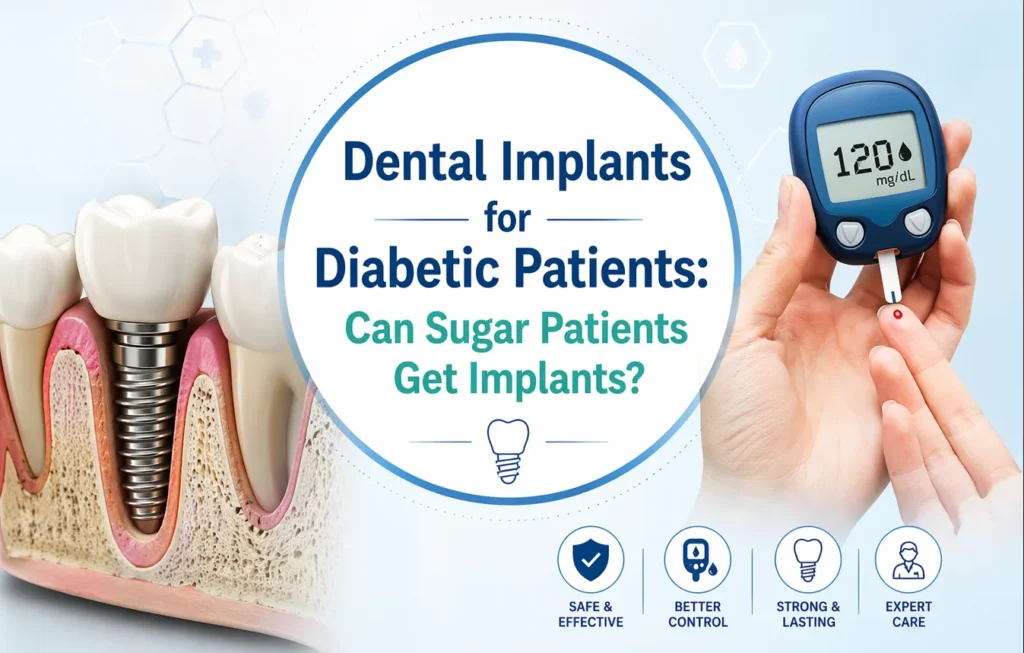
India has more than 77 million people living with diabetes. That is one of the largest diabetic populations in the world. And a significant number of these patients also suffer from missing teeth, often made worse by the gum disease and tooth decay that high blood sugar promotes.
So when diabetic patients come to me at Smilessence in Gurgaon and ask “can I still get dental implants?”, this is not a rare or unusual question. I hear it every week.
The answer is yes – diabetic patients can get dental implants, provided blood sugar is well
controlled. That one condition, blood sugar control, is what separates a successful implant outcome in a diabetic patient from a risky one. It is not diabetes itself that is the problem. It is uncontrolled blood sugar.
In this article, I will walk you through exactly what the research says, what the HbA1c numbers mean for your eligibility, how Type 1 and Type 2 diabetes differ in this context, and what the preparation process looks like at Smilessence for diabetic patients considering implants.
Why Diabetes Affects Dental Implants
To understand the challenge, you need to understand what high blood sugar does to your body’s healing process.
When a dental implant is placed in your jaw, it needs to fuse with the surrounding bone over a period of 10 to 16 weeks. This process, called osseointegration, depends on your body’s ability to form new bone cells, fight bacteria around the surgical site, and maintain healthy circulation to the healing tissue. High blood sugar (hyperglycaemia) interferes with all three of these processes:
- Slower healing: Elevated glucose impairs the function of white blood cells, which are your body’s infection fighters. Wounds take longer to close and are more vulnerable to bacteria during that extended healing window.
- Reduced bone formation: High glucose interferes with calcium absorption and the activity of osteoblasts, the cells responsible for building new bone around an implant. This can slow or compromise osseointegration.
- Higher infection risk: Diabetic patients are significantly more prone to oral infections, including gum disease. The gum tissue around a healing implant is particularly vulnerable if blood sugar is poorly controlled.
- Impaired blood supply: Long-standing diabetes damages small blood vessels (microvascular damage). Healthy blood supply to healing tissue is essential for successful implant integration.
Here is the critical insight: all of these effects are directly tied to the level of blood sugar control, not to the diagnosis of diabetes itself. A diabetic patient who maintains excellent glycaemic control has a healing environment that is only marginally different from a non-diabetic patient. That is what the clinical research consistently shows.
92-95%Implant survival rate in well-controlled diabetics
95%+Implant survival rate in non-diabetics
77M+Diabetics in India who may need tooth replacement
The HbA1c Number That Decides Your Eligibility
HbA1c (glycated haemoglobin) is the standard blood test that measures your average blood sugar level over the past 2 to 3 months. It is the most important number we look at when assessing a diabetic patient for implant surgery. Your recent fasting glucose reading tells us what your sugar was today. Your HbA1c tells us how well your diabetes has been managed over the past several months – which is what actually matters for healing.
| HbA1c Level | Diabetes Control | Implant Recommendation |
|---|---|---|
| Below 7% | Well controlled | Proceed with standard implant protocol. Success rate comparable to non-diabetics. |
| 7% to 8% | Reasonably controlled | Implants can proceed with additional precautions – antibiotic cover, closer monitoring, extended healing time expected. |
| 8% to 10% | Moderately controlled | Implants are a higher risk. Work with your physician to improve control first. Some cases proceed with intensive management protocol. |
| Above 10% | Poorly controlled | Defer implant treatment. Focus on bringing HbA1c below 8% before considering surgery. Risk of implant failure and serious infection is significantly elevated. |
The practical takeaway: If your HbA1c is below 7% and your fasting blood sugar is consistently within range, your implant eligibility is very close to that of a non-diabetic patient. If your sugar is not well controlled, the first step is not to rule out implants permanently. The first step is to work with your physician to bring it under control. Many patients who could not proceed initially were successfully treated after 3 to 6 months of improved diabetic management.
Can Type 2 Diabetics Get Dental Implants?
Yes. Type 2 diabetes is by far the more common type among our patients, and the clinical evidence for implant success in well-controlled Type 2 diabetics is strong.
Multiple published studies report implant survival rates of 92% to 100% in Type 2 diabetic patients with good glycaemic control, with outcomes that are statistically very close to non-diabetic patients. A 2010 study by Turkyilmaz reported 100% implant survival at one year in well-controlled and moderately controlled Type 2 diabetic patients. A 2000 study by Morris reported a 92.2% three-year survival rate in 255 implants placed in Type 2 diabetics.
Type 2 diabetics also benefit from the fact that insulin is still present in their tissues, even if cells are resistant to it. This has a moderating effect compared to the complete insulin deficiency of Type 1 diabetes. If your Type 2 diabetes is managed effectively through medication, diet, or both, implant surgery is very much on the table.
Can Type 1 Diabetics Get Dental Implants?
Yes, but with greater care and monitoring.
Type 1 diabetes involves complete insulin deficiency, which creates a more challenging healing environment than Type 2. Clinical research shows that Type 1 diabetics have a higher implant failure rate than Type 2 diabetics, and blood sugar fluctuations tend to be harder to stabilise. This does not mean implants are not possible. It means the pre-operative preparation, the intraoperative protocol, and the post-operative monitoring need to be more careful and more thorough.
For Type 1 diabetic patients, we work closely with the patient’s endocrinologist before scheduling any implant surgery. Blood sugar logs are reviewed, HbA1c is confirmed, and a detailed perioperative blood sugar management plan is agreed upon before surgery takes place.
Dental Implants for Sugar Patients in India
In India, diabetes is often referred to as “sugar” or “madhumeh” and patients frequently ask about implants using this term. If you have sugar and are missing teeth, everything in this article applies to you.
What is particularly relevant in the Indian context is that uncontrolled diabetes and dental neglect often go hand in hand. High blood sugar promotes gum disease, which leads to tooth loss. Tooth loss left unreplaced leads to bone loss. And patients who have lived with sugar for many years often have multiple missing teeth, bone loss, and gum disease all at once by the time they come to us.
The good news is that all of these issues can be addressed sequentially:
- Gum disease is treated first through our gum treatment programme, which removes infection and stabilises the tissue.
- Blood sugar is brought under control with the patient’s physician before surgery is scheduled.
- Bone loss is assessed through 3D imaging. Where needed, bone grafting or All-on-4 techniques address insufficient bone. You can read more about this in our detailed guide: can I get dental implants with bone loss.
- Implants are placed under an enhanced protocol that includes antibiotic cover, close blood sugar monitoring, and a longer healing review schedule.
With this structured approach, sugar patients who were initially unsuitable for implants routinely go on to have very successful treatment at Smilessence.
Dental Implants for Diabetics with Bone Loss
This is a particularly common combination. Diabetes promotes gum disease, which destroys bone. Long-term diabetics who have lost multiple teeth often have significant bone loss by the time they consider implants.
Having diabetes and bone loss together does not rule out implants. It means treatment requires more planning. In most of these cases, All-on-4 implants are the most appropriate solution. All-on-4 uses angled implants to find and anchor into the denser bone that remains even when significant resorption has occurred elsewhere in the jaw. Research specifically in diabetic patients with All-on-4 shows success rates very similar to non-diabetics when blood sugar is controlled.
For patients with more localised bone loss affecting individual implant sites, bone grafting after the gum disease is resolved is another effective route.
Why Dental Implants Are Actually Better Than Dentures for Diabetics
This is a point many patients have not considered. Most diabetic patients who come to us have been wearing dentures, and many assume that dentures are the “safer” option because they do not involve surgery.
The opposite is often true. Here is why implants are better for diabetic patients specifically:
- Diet and blood sugar management: Diabetic health depends on eating the right foods. Whole grains, fresh vegetables, lean proteins, and fibre-rich foods are essential. But these foods require proper chewing. Poorly fitting dentures make chewing painful and difficult, pushing patients toward soft, processed, high-carbohydrate foods that spike blood sugar. Implants restore full chewing function, supporting better dietary choices and therefore better blood sugar management.
- Gum health: Ill-fitting dentures cause pressure sores, irritation, and chronic inflammation of the gum tissue. For diabetic patients who are already prone to slow-healing oral wounds, these denture sores are a persistent source of low-grade infection. Implants eliminate this problem entirely.
- Bone preservation: Dentures accelerate bone loss by providing no stimulation to the jaw. Implants prevent further bone loss by acting as functional tooth roots. A diabetic patient who loses bone rapidly has fewer options for future dental treatment.
- Confidence and compliance: Patients who are comfortable eating the foods that support their diabetic diet are more likely to maintain good blood sugar control. A fixed, secure set of teeth supports this in a way that unstable dentures simply do not.
The Pre-Operative Protocol for Diabetic Patients at Smilessence
If you are a diabetic patient considering implants, here is exactly what the preparation process looks like at our clinic:
- HbA1c blood test: We request a current HbA1c result (within the last 3 months) before any implant planning. If your last test was over 3 months ago, we ask you to get a fresh one before your consultation.
- Physician clearance: For HbA1c above 7.5%, we ask for written clearance from your physician or endocrinologist confirming that your diabetes is under management and you are medically fit for a minor surgical procedure.
- 3D imaging: A CBCT cone beam 3D scan assesses your exact bone volume, density, and anatomy. This tells us precisely what implant type and placement approach is appropriate.
- Gum disease treatment: If active periodontitis is present, this is treated and resolved completely before implant surgery is scheduled. We re-assess gum health at a follow-up appointment before proceeding.
- Antibiotic cover: Diabetic patients receive antibiotic prophylaxis before and after implant surgery to reduce infection risk during the healing phase.
- Blood sugar on surgery day: On the day of surgery, your fasting blood glucose is recorded. We aim for a reading below 180 mg/dL before proceeding. If it is higher, we reschedule to protect your safety.
- Extended monitoring schedule: Diabetic patients are reviewed more frequently during osseointegration – typically at 4 weeks, 8 weeks, and 12 weeks – to catch and address any early signs of complication promptly.
Important: Never stop your diabetes medications before dental surgery without consulting your physician. Some medications may need dose adjustment around surgery, but stopping them entirely can cause dangerous blood sugar spikes. Always disclose your full medication list to your implant specialist before treatment begins.
Should Diabetics Get Dental Implants?
If your blood sugar is well managed and you have missing teeth, yes, implants are absolutely something you should consider seriously. The alternative, leaving gaps or relying on dentures, carries its own health costs for diabetic patients – nutritional compromise, gum irritation, bone loss, and reduced quality of life.
The question to ask is not “should I avoid implants because I have diabetes?” The question is “is my diabetes well enough controlled to give implants the best chance of success?” If the answer is yes, implant treatment is a sound, evidence-backed choice. If the answer is not yet, the priority is improving that control first, with the goal of making implant treatment safe and predictable.
To learn more about what makes you a suitable candidate for implants beyond the diabetes question, read our guide: who is a good candidate for dental implants. Browse more articles on our dental blog for guidance on every aspect of implant treatment.
Frequently Asked Questions
Can diabetics get dental implants?
Yes. Diabetic patients with well-controlled blood sugar can get dental implants with success rates that are very close to those of non-diabetic patients. The key requirement is that HbA1c is below approximately 7 to 8% before surgery is scheduled. The diagnosis of diabetes is not a disqualifier. Uncontrolled blood sugar is the concern, and that is something that can be addressed with your physician before moving forward.
Are dental implants safe for diabetics?
Yes, when properly planned and performed with appropriate precautions. Diabetic patients at Smilessence receive antibiotic cover before and after surgery, have blood glucose confirmed on surgery day, undergo 3D imaging for precise implant placement, and are monitored more frequently during the healing period. These precautions make the procedure safe and predictable. Multiple published clinical studies confirm that dental implants are a safe and effective option for patients with controlled diabetes.
Can type 2 diabetics get dental implants?
Yes, and this is the most common situation we treat. Type 2 diabetics with HbA1c below 8% have excellent implant outcomes, with reported survival rates of 92% to 100% across multiple clinical studies. Type 2 diabetes, when well managed, is considered only a relative risk factor for implants, not an absolute contraindication. Our full assessment protocol for diabetic patients is available when you book a consultation for dental implants cost in Gurgaon.
Can sugar patients get tooth implants in India?
Yes. Having “sugar” (diabetes) does not mean you cannot get implants. What matters is whether your sugar is under control. At Smilessence in Gurgaon, we treat diabetic patients for dental implants in Gurgaon regularly, with a structured protocol that addresses blood sugar status, gum health, and bone condition before any surgery is scheduled. If your sugar is not currently well controlled, we guide you on what needs to be done first so you can become a suitable candidate.
What HbA1c level is needed for dental implants?
Most implant specialists, including us at Smilessence, prefer to see HbA1c below 7% before proceeding with standard implant surgery. Between 7% and 8% is manageable with additional precautions. Between 8% and 10% carries moderately elevated risk and we would typically ask for further blood sugar improvement first. Above 10% is considered poorly controlled, and implant surgery is deferred until better control is achieved. These are guidelines, not rigid rules. Each patient is assessed individually.
Do dental implants last as long for diabetic patients?
For patients with well-controlled diabetes, the long-term survival of implants is very close to that of non-diabetic patients. Where diabetes is not well controlled, the risk of peri-implantitis (infection around the implant) and eventual implant loss increases. This reinforces why ongoing blood sugar management after your implants are placed is just as important as before surgery. Twice-yearly check-ups at your dental clinic help catch any early peri-implant changes before they become a problem.
I have diabetes and bone loss. Can I still get implants?
In most cases, yes. Diabetes and bone loss together are a common combination that we manage regularly at Smilessence. All-on-4 implants are particularly effective for diabetic patients with bone loss, as the technique uses angled placement to work with whatever bone remains without requiring extensive grafting. Once your blood sugar is under control and any gum disease is resolved, a 3D scan will show exactly which approach is right for your jaw anatomy. See our detailed article: can I get dental implants with bone loss.
Are You a Diabetic Patient Considering Dental Implants?
Book a consultation with Prof. Dr. Vineet Vinayak at Smilessence. Bring your latest HbA1c report. We will assess your blood sugar status, gum health, and bone volume in one appointment and give you a clear treatment plan.
We treat diabetic patients for dental implants every week. You are not in unusual territory here.
Call or WhatsApp: +91 9811 303 933 | +91 9811 334 633
SFF/102, Ansal Palam Triangle, Palam Vihar, Gurgaon 122017 | Mon to Sun, 9 AM to 8:30 PM
In This Article
- The answer is yes – diabetic patients can get dental implants, provided blood sugar is well
- Why Diabetes Affects Dental Implants
- The HbA1c Number That Decides Your Eligibility
- Can Type 2 Diabetics Get Dental Implants?
- Can Type 1 Diabetics Get Dental Implants?
- Dental Implants for Sugar Patients in India
- Dental Implants for Diabetics with Bone Loss
- Why Dental Implants Are Actually Better Than Dentures for Diabetics
- The Pre-Operative Protocol for Diabetic Patients at Smilessence
- Should Diabetics Get Dental Implants?
- Frequently Asked Questions
Want to Fix Missing Teeth Today?
Book a clinical assessment. We identify the source and start treatment the same day.
Book at Smilessence The Specialist Dental Centre Gurgaon +91 9811 303 933