
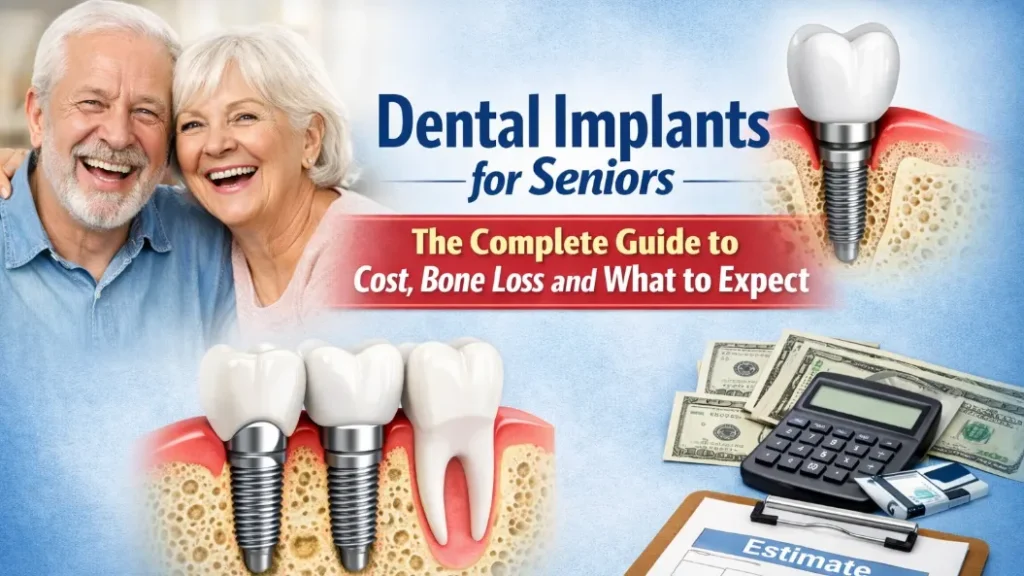
The single most common misconception I encounter from senior patients is this: “I am too old for dental implants.”
They are not. And the science backs that up clearly.
There is no upper age limit for dental implants. Age alone is never a disqualifying factor. Patients in their 70s, 80s, and even 90s receive dental implants successfully every day. What determines whether implants work for a senior patient is not how old they are. It is their bone health, their general medical condition, and the medications they are on. All of these can be assessed, and most can be managed.
In this guide, I will walk you through everything a senior patient or their family needs to know before making this decision: the real success rates, what happens with bone loss, how osteoporosis and cardiac medications affect eligibility, the cost breakdown, and whether implants genuinely make sense compared to continuing with dentures.
What the Research Actually Says About Seniors and Dental Implants
Let us start with data, because this question deserves facts rather than assumptions.
92.9%
Long-term implant survival in patients aged 60+ (PubMed, 1,256 implants)
Long-term implant survival in patients aged 60+ (PubMed, 1,256 implants)
92-96%
Success rate for seniors aged 65+, comparable to younger adults
Success rate for seniors aged 65+, comparable to younger adults
95%
Chewing efficiency with implants vs 10-15% with traditional dentures
Chewing efficiency with implants vs 10-15% with traditional dentures
A published PubMed long-term study examining 1,256 implants placed in patients aged 60 and above found an overall survival rate of 92.9%. A large-scale BMC Oral Health study covering 158,000 implants found a 97.79% overall survival rate. PMC research from 2025 confirms that dental implants in adults over 80 show success rates comparable to younger patients when bone density is adequate and systemic health is controlled.
The takeaway: age slightly increases the complexity of treatment planning. It does not significantly reduce the probability of success when a specialist manages the case properly.
Why Seniors Are Often Excellent Implant Candidates
This may surprise you, but senior patients often have several advantages over younger patients when it comes to dental implants.
- The jaw is fully stable. A senior’s jaw has long stopped growing and changing. Unlike younger patients where residual jaw development can shift implant position over years, an older patient’s implant stays exactly where it is placed. This is a genuine advantage for long-term stability.
- Senior patients tend to be highly compliant. In over 22 years of implant practice, I consistently find that older patients follow post-operative instructions carefully, attend all check-up appointments, and take excellent care of their implants. Patient compliance is one of the most important predictors of long-term implant success, and seniors score very well on this.
- The quality-of-life benefit is dramatic. A senior patient who has been struggling with uncomfortable dentures for years experiences a profound, immediate improvement in daily life when implants restore full chewing function. The benefit is not gradual. It is felt with the first meal.
- Lifestyle risk factors are often lower. Many seniors have reduced or stopped smoking. Heavy physical contact with teeth is less common. These factors contribute to a lower-risk healing environment for implant osseointegration.
Dental Implants for Seniors with Bone Loss
Bone loss is the most common challenge we encounter in senior implant cases. It is also, in the majority of cases, something we can work with or around.
Why is bone loss so prevalent in older patients? Every year a tooth sits missing in the jaw, the bone beneath that gap continues to resorb because it is no longer being stimulated by chewing forces. Many senior patients have had missing teeth or worn dentures for a decade or more by the time they seek implant treatment. Add to this the natural reduction in bone density that occurs with ageing, and significant bone loss is a very common starting point.
But it is rarely the end of the road. Here is what becomes possible depending on severity:
Mild to moderate bone loss: standard implants with or without grafting
Where bone has reduced but sufficient volume remains, standard implants can often be placed directly, sometimes with a minor bone augmentation done at the same time as surgery. Where the deficiency is more significant, bone grafting rebuilds the volume needed over 3 to 6 months before implant placement. This is a routine procedure. Read the full guide on dental implants with bone loss for a detailed breakdown by severity.
Significant bone loss across multiple teeth: All-on-4 implants
For senior patients who have lost most or all of their teeth and have significant bone loss throughout the jaw, All-on-4 dental implants are one of the most effective solutions available. The technique places four implants at strategic angles to anchor into the denser bone that remains at the front of the jaw, even when much of the posterior bone has resorbed. All-on-4 frequently eliminates the need for bone grafting even in substantial bone loss cases. Same-day temporary teeth are possible in most cases, meaning a senior patient can arrive in the morning and leave in the evening with fixed, functional teeth.
Severe upper jaw bone loss: sinus lift
Long-term bone loss in the upper jaw often causes the sinus floor to drop too close to the jaw surface for standard implant placement. A sinus lift raises the sinus membrane and places graft material beneath it, creating the height needed. This adds 3 to 6 months to treatment time but opens the door to implants in patients who would otherwise have no route to fixed upper teeth.
The one thing no one can tell you without a scan: Exactly what your bone can support. A 3D CBCT imaging assessment is the only reliable way to know your bone volume, density, and anatomy. Any specialist who tells you that you cannot get implants due to bone loss without first taking a 3D scan is not giving you a complete picture. The scan takes minutes and changes everything about what treatment options become visible.
Osteoporosis and Dental Implants: Clearing Up the Confusion
Many senior patients, particularly women, come to us worried that their osteoporosis automatically rules out dental implants. It typically does not.
Multiple published clinical studies have found that patients with osteoporosis have healing times and implant survival rates comparable to patients without the condition. The jaw maintains relatively good bone density even when osteoporosis affects other skeletal areas such as the hips and spine. Most patients with osteoporosis are successfully treated with dental implants without any significant additional risk.
The nuance involves bisphosphonate medications, which are commonly prescribed for osteoporosis. Oral bisphosphonates such as Alendronate (Fosamax) and Risedronate require physician coordination before implant surgery in some cases. In rare instances, a drug holiday may be discussed with your physician. This is manageable and does not prevent treatment for the vast majority of patients. IV bisphosphonates used in cancer treatment carry a higher but still manageable risk and require specialist evaluation.
Common Senior Medications and Their Impact on Implants
Senior patients typically take multiple medications. Always bring a complete medication list to your implant consultation. Here is how the most common categories are managed:
Generally fine
Blood pressure medications, statins (cholesterol), thyroid medications, Metformin for diabetes, vitamin D and calcium supplements. These do not significantly affect implant healing when the underlying conditions are stable.
Requires review
Oral bisphosphonates for osteoporosis, oral corticosteroids, immunosuppressants. Your implant specialist will coordinate with your physician. Treatment is still usually possible with appropriate planning.
Must be disclosed
Blood thinners (Warfarin, Clopidogrel, Rivaroxaban), IV bisphosphonates (cancer treatment). These require physician coordination for dose management around surgery. They do not automatically prevent implant treatment but need careful planning and timing.
Implants vs Dentures for Seniors: An Honest Comparison
The choice between continuing with dentures and pursuing implants is one of the most significant quality-of-life decisions a senior patient can make. Here is an honest side-by-side comparison:
Dental Implants
- 95% chewing efficiency – eat what you want
- Fixed permanently, never moves
- No adhesives, no removal at night
- Stimulates jawbone, stops further resorption
- Maintains facial structure, prevents sunken appearance
- Supports proper nutrition – fresh vegetables, proteins, whole foods
- No gum sores from pressure or friction
- Lifetime solution with good care
Long-term Dentures
- 10-15% chewing efficiency – significant diet restriction
- Moves and slips, especially as bone recedes further
- Requires adhesives, must be removed daily
- Accelerates bone loss beneath the denture base
- Bone shrinkage causes progressive facial changes
- Soft, processed foods become the default over time
- Gum sores, pressure points, and irritation are common
- Relining or replacement every 5 to 7 years
The chewing efficiency difference is particularly important for seniors. A diet restricted by poorly fitting dentures pushes older adults toward soft, processed, high-carbohydrate foods that are easier to manage but nutritionally inferior. The ability to eat fresh vegetables, lean proteins, and fibre-rich whole foods supports immune function, bone health, and overall wellbeing in ways that a denture-limited diet simply cannot. This is not a minor point. It is a meaningful health consideration.
For senior patients who want to improve denture stability without committing to full implant surgery immediately, an implant-supported denture using just two to four implants is an excellent intermediate option that transforms denture stability at considerably lower cost.
Dental Implants Cost for Senior Patients
Cost is an important consideration, and senior patients deserve transparent numbers rather than vague estimates. Here is what dental implant treatment costs at Smilessence:
| Treatment | Approx. Cost | Best Suited For |
|---|---|---|
| Single tooth implant (Astra Tech) | Rs. 25,000 – Rs. 45,000 | One or a few missing teeth with adequate bone |
| Implant-supported denture (2 implants per arch) | Rs. 70,000 – Rs. 1,20,000 | Existing denture wearers wanting stability |
| All-on-4 per arch | Rs. 2,50,000 – Rs. 4,00,000 | Full arch with significant bone loss |
| All-on-6 per arch | Rs. 3,50,000 – Rs. 5,50,000 | Full arch with better bone, maximum stability |
| Bone grafting (where needed) | Rs. 10,000 – Rs. 30,000 per site | Added where bone volume is insufficient |
All costs are indicative and confirmed at consultation after 3D imaging. Flexible EMI payment plans are available for senior patients who prefer to spread the cost over several months.
It is worth comparing these one-time costs against the long-term cost of dentures. A full set of dentures needs relining, repairs, and complete replacement every 5 to 7 years. Over a 15 to 20 year period, the cumulative maintenance cost of dentures often approaches or exceeds the one-time cost of implants. Implants, maintained well, require no replacement of the post itself. The crown or prosthesis may need attention after many years, but the implant structure is permanent. Full dental implants cost in Gurgaon details are available on our treatment page.
The Treatment Process for Senior Patients
Senior patients at Smilessence go through a more thorough initial assessment than younger patients, because the medical variables matter more. Here is what the process looks like:
- Full medical and medication review: We review all conditions and all medications before any treatment is planned. Cardiovascular conditions, diabetes, osteoporosis, and blood thinners are all relevant. Bring your complete medication list and latest blood reports.
- 3D CBCT imaging: In-house 3D scan maps bone volume, density, nerve positions, and sinus anatomy. This is the foundation of every implant plan for senior patients.
- Physician coordination: Where relevant medications or health conditions require it, we coordinate with your physician before scheduling surgery. This protects you and ensures the procedure is safe and well-timed.
- Gum treatment if needed: Active gum disease is treated and resolved before implant surgery proceeds. Healthy soft tissue around the implant site is essential for healing. See our gum treatment programme.
- Bone grafting if needed: Scheduled 3 to 6 months before implant surgery where insufficient bone volume is confirmed on the scan.
- Implant surgery: Performed under local anaesthesia. Comfortable for most senior patients. Duration ranges from 60 minutes for single implants to 2 to 4 hours for full-arch cases.
- Closely monitored healing: Senior patients are reviewed at 4, 8, and 12 weeks during osseointegration. We watch carefully and act quickly if any early complication arises.
- Final restoration: Permanent crown or prosthesis fitted once osseointegration is confirmed, typically 12 to 16 weeks after surgery.
Frequently Asked Questions
Is there a maximum age for dental implants?
No. There is no upper age limit. Patients in their 70s, 80s, and 90s receive dental implants successfully. PMC 2025 research confirms that implants in adults over 80 show success rates comparable to younger patients when bone density is adequate and systemic health is controlled. Age is not the deciding factor. Bone quality and general health are.
Can seniors get dental implants with bone loss?
Yes, in most cases. Bone loss is the most common starting point for senior implant patients, not a permanent barrier. Bone grafting rebuilds lost volume before standard implant placement. All-on-4 uses angled implants to anchor into remaining bone without requiring extensive grafting. The right solution depends on the type and extent of bone loss, which a 3D scan clarifies. Read the full guide: can I get dental implants with bone loss.
How much do dental implants cost for seniors?
A single implant costs approximately Rs. 25,000 to Rs. 45,000. Implant-supported dentures start from Rs. 70,000 per arch. All-on-4 full arch starts from Rs. 2,50,000. Bone grafting adds Rs. 10,000 to Rs. 30,000 per site where needed. All costs are confirmed at consultation after 3D imaging. EMI options available. See full details: dental implants in Gurgaon treatment page.
Are dental implants safe for seniors with heart conditions or diabetes?
Yes, with proper planning. Controlled cardiac conditions and well-managed diabetes are not contraindications. We coordinate with your cardiologist or physician and review all medications before surgery is scheduled. Uncontrolled diabetes should be managed to a safe HbA1c level first. Read the dedicated guide: dental implants for diabetic patients.
Does osteoporosis prevent seniors from getting implants?
In most cases, no. Clinical research consistently shows osteoporosis patients achieve implant success rates comparable to those without the condition. The jaw maintains relatively good density even when osteoporosis affects the hips and spine. Patients on oral bisphosphonates for osteoporosis require physician coordination but are usually able to proceed with treatment. Patients on IV bisphosphonates need specialist evaluation.
Is it worth getting dental implants at 70 or older?
For most patients, yes. A 70-year-old in good health has 15 to 20 or more years ahead. Implants placed today provide those years with proper chewing function, preserved bone structure, and the ability to eat anything. The quality-of-life improvement from switching off long-term dentures is consistently reported by patients as dramatic. The alternative, continuing with deteriorating dentures, carries its own compounding costs and limitations. For the right patient, implants are an excellent long-term investment at any age past 18.
How do I find dental implants for seniors near me?
Look for a specialist implant centre with an MDS-qualified implantologist rather than a general dentist, in-house 3D imaging capability, and a specific track record of treating senior patients with complex medical profiles. At Smilessence, Prof. Dr. Vineet Vinayak (BDS, MDS – Endodontics and Implantology) has been treating senior implant patients for over 22 years, with in-house 3D imaging, full physician coordination, and 1,153+ Google reviews as India’s top-rated implant centre. Browse our dental blog for more treatment guides.
Senior Patient? Book a Specialist Implant Consultation at Smilessence, Gurgaon
Prof. Dr. Vineet Vinayak has over 22 years of specialist experience treating senior patients for dental implants. We understand the medical complexity, the family considerations, and the genuine life impact a successful implant has on an older patient’s daily wellbeing.
Bring your complete medication list and latest blood reports. We will assess your bone, review your health history, and give you a clear, honest treatment plan at your first appointment.
Call or WhatsApp: +91 9811 303 933 | +91 9811 334 633
SFF/102, Ansal Palam Triangle, Palam Vihar, Gurgaon 122017 | Mon to Sun, 9 AM to 8:30 PM
In This Article
- What the Research Actually Says About Seniors and Dental Implants
- Why Seniors Are Often Excellent Implant Candidates
- Dental Implants for Seniors with Bone Loss
- Mild to moderate bone loss: standard implants with or without grafting
- Significant bone loss across multiple teeth: All-on-4 implants
- Severe upper jaw bone loss: sinus lift
- Osteoporosis and Dental Implants: Clearing Up the Confusion
- Common Senior Medications and Their Impact on Implants
- Implants vs Dentures for Seniors: An Honest Comparison
- Dental Implants
- Long-term Dentures
- Dental Implants Cost for Senior Patients
- The Treatment Process for Senior Patients
- Frequently Asked Questions
- Senior Patient? Book a Specialist Implant Consultation at Smilessence, Gurgaon
Want to Fix Missing Teeth Today?
Book a clinical assessment. We identify the source and start treatment the same day.
Book at Smilessence The Specialist Dental Centre Gurgaon +91 9811 303 933