
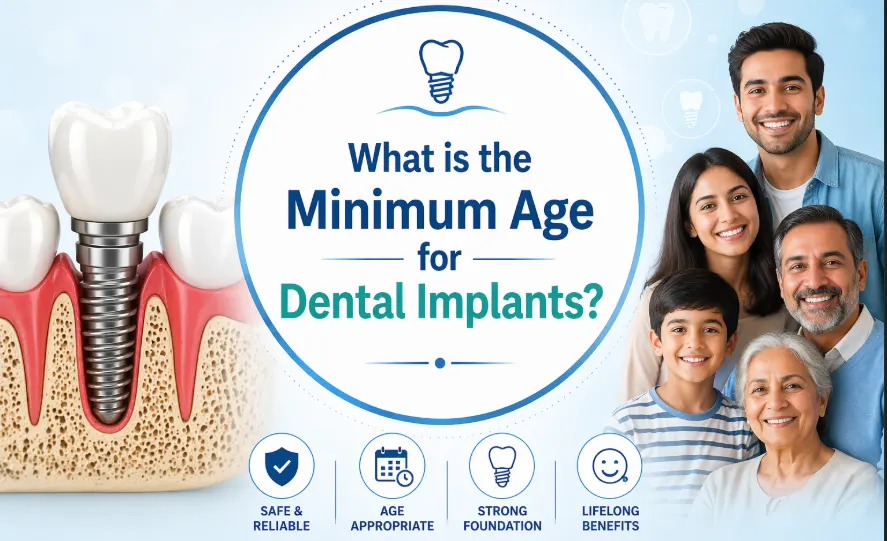
The short answer: 18 years old is the general minimum age for dental implants. But here is what most people do not know. Age is just a number. What actually decides whether you or your child can get a dental implant is the state of the jawbone, not the date on a birth certificate.
I have seen 17-year-olds with fully mature jaw development who were excellent candidates. I have also seen 20-year-olds whose bone was still growing and who needed to wait. The real question is never “how old are you?” It is “has your jaw stopped growing?”
In this post, I will walk you through exactly how age and jaw development interact, what happens if someone is too young for implants, and whether there is any upper age limit you need to worry about. (Spoiler: there is not.)
Why Age Matters for Dental Implants
A dental implant is a titanium post that is anchored permanently into your jawbone. Once it integrates with the bone through a process called osseointegration, it becomes part of your jaw. That is what makes it so stable and so long-lasting.
Now imagine placing a permanent anchor into a jaw that is still growing. As the jaw continues to develop, it shifts and expands. The implant, being fixed in place, does not move with it. The result is a misaligned implant that no longer sits correctly, fails to function properly, or creates problems with adjacent teeth.
This is the core reason why there is a minimum age for dental implants. It is not a legal restriction. It is a biological one. The jaw must finish growing before an implant can be placed safely and with long-term success.
When Does the Jaw Stop Growing?
This is where it gets interesting, because the jaw does not stop growing at the same age for every person.
In general:
- Girls typically reach skeletal maturity (including jaw development) between 16 and 18 years of age.
- Boys tend to develop more slowly and often reach skeletal maturity between 18 and 21 years of age. Some continue developing into their mid-twenties.
Because of this variation, the guideline of “18 years old” is a starting point, not a finish line. At Smilessence, we do not make this decision based on age alone. We use digital dental X-rays and 3D scans to assess actual bone development before recommending any implant procedure for a younger patient.
How we assess jaw maturity: One reliable method is reviewing an X-ray of the wrist alongside jaw imaging. The growth plates in the wrist give a clear picture of whether skeletal development is complete. If the growth plates are closed, the body has generally reached its final bone structure.
What Happens if You Are Under 18 and Have a Missing Tooth?
Losing a tooth as a teenager is more common than most people think. Sports injuries, accidents, severe decay, and certain developmental conditions can all result in a missing permanent tooth at a young age.
The good news is that you do not have to go without a tooth while you wait. There are interim solutions that work well for younger patients until they are ready for an implant:
Option 1: A removable partial denture
A custom-made removable partial denture fills the gap cosmetically and functionally. It is not a permanent solution, but it maintains the appearance of a full smile and prevents adjacent teeth from drifting into the space. It can be updated as the jaw continues to develop.
Option 2: A dental flipper
A flipper is a lightweight, temporary removable appliance with one or more artificial teeth. It is comfortable, affordable, and gives a younger patient a functional tooth while they wait for the jaw to mature.
Option 3: A resin-bonded bridge (Maryland bridge)
For certain cases, especially front teeth, a resin-bonded bridge provides a fixed temporary option. Unlike a traditional dental bridge, a Maryland bridge does not require grinding down adjacent teeth. It bonds to the back of neighbouring teeth with minimal preparation. This can be a good medium-term solution before a permanent implant is placed.
What we strongly advise against: Leaving the gap empty. Even for a few months, an empty tooth socket causes the surrounding teeth to slowly drift and the bone beneath to begin resorbing. This makes future implant placement more complex and costly. Always replace a missing tooth, even temporarily.
Is There a Maximum Age Limit for Dental Implants?
No. There is no upper age limit for dental implants.
This surprises many patients, particularly those in their 60s, 70s, and beyond who assume they have “missed the window.” They have not. Studies consistently show implant success rates above 95% even in patients in their 80s and 90s. At Smilessence, some of our most successful implant cases have been in patients well into their seventies who had spent years uncomfortable with ill-fitting dentures.
What matters for older patients is not age but bone quality and general health, both of which can be assessed and managed. Read more about dental implants in Gurgaon to understand what the assessment involves.
Age vs. What Actually Determines Implant Eligibility
Let me be direct about this. Age is a proxy. What we are really asking when we discuss age is: are the underlying conditions for a successful implant present? Here is what that actually means:
| Factor | What We Look For | Relevant Age Group |
|---|---|---|
| Jaw development | Bone growth plates closed; jaw dimensions stable | Teens and young adults under 21 |
| Bone density | Sufficient bone volume and density at the implant site | All ages, especially 50+ |
| Gum health | No active gum disease or periodontitis | All ages |
| General health | No uncontrolled diabetes, blood disorders, or active cancer treatment | All ages, especially 60+ |
| Oral hygiene | Consistent brushing and flossing; low cavity risk | All ages |
| Non-smoker | Or willing to stop during healing (smoking impairs osseointegration) | All ages |
If all of these factors are in place, an 18-year-old and a 75-year-old are both equally strong candidates for dental implants. The treatment is assessed individually, not by age bracket.
The Best Age to Get Dental Implants
Here is a question I get asked often: “If I can get implants now, should I, or should I wait?”
My answer is always the same. If your jaw has matured, your oral health is good, and you have a missing tooth, sooner is better. Here is why:
- Bone loss starts immediately. From the moment a tooth is removed, the jawbone beneath it begins to shrink because it is no longer being stimulated. The longer you wait, the more bone you lose, and the more complex (and expensive) the eventual implant procedure becomes.
- Adjacent teeth drift. Neighbouring teeth slowly lean into the gap over time, changing your bite and creating alignment problems.
- Young bone heals faster. Younger adults typically osseointegrate faster and recover more quickly from implant surgery than older patients.
If you are in your late teens or early twenties and a dentist has confirmed your jaw is mature, do not delay. Getting an implant at 20 means you enjoy that tooth for potentially 50 or 60 years. That is a remarkable return on investment.
For patients considering multiple missing teeth or full arch restoration, understanding the options like All-on-4 implants or All-on-6 implants can help plan the right treatment at the right time.
A Word on Teenage Patients and Implants in India
In India, teenage tooth loss from sports injuries and road accidents is a significant clinical reality. I see parents bring in teenagers with knocked-out or non-restorable front teeth, desperate for a permanent solution. The instinct is completely understandable. No parent wants to watch their child go through adolescence with a visible gap in their smile.
The compassionate and responsible answer is to provide the best interim solution possible while the jaw matures, and then place the implant when the timing is right. A well-placed implant at 19 or 20 after proper jaw assessment will serve that patient for decades. An implant placed too early at 15 or 16 risks failure, misalignment, and a far more complicated situation to correct later.
Patience here is genuinely in the patient’s best interest, even when it does not feel that way in the moment.
Frequently Asked Questions
Can a 16-year-old get a dental implant?
In most cases, no. At 16, the jaw is still actively developing, particularly in boys. Placing an implant into a growing jaw risks misalignment and failure as bone continues to change. A dental assessment including growth plate imaging can confirm whether development is complete, but for most 16-year-olds, interim solutions like a flipper or Maryland bridge are more appropriate while waiting for jaw maturity.
At what age can I get a dental implant in India?
The clinical guideline is 18 years, though this is assessed individually through jaw X-rays rather than strictly by age. Some patients at 17 or 18 may not yet be ready; others at 18 will be ideal candidates. A consultation with an MDS implantologist including digital 3D X-ray is the only reliable way to know your specific situation.
Can senior citizens (60+) get dental implants?
Absolutely. There is no upper age limit. At Smilessence, we regularly place implants in patients in their 60s, 70s, and beyond. The key factors are bone density and general health, both of which are fully assessed before treatment. Where bone has been lost over time, dental implant treatment in Gurgaon can rebuild the site before implant placement.
My child lost a tooth in an accident. What should we do right now?
First, do not leave the gap empty. Get a temporary replacement fitted as soon as possible. A dental flipper or removable partial denture will maintain the space, prevent adjacent teeth from drifting, and give your child a natural-looking smile while the jaw continues to develop. Plan to reassess for an implant from age 18 onwards once jaw maturity is confirmed.
Does jaw development affect upper and lower teeth differently?
Yes. The upper jaw (maxilla) and lower jaw (mandible) develop at slightly different rates, and bone quality differs between them. The upper jaw naturally has softer, less dense bone than the lower jaw. This is one reason why full-arch upper jaw restorations sometimes require more implants for optimal stability, which is why All-on-6 implants are often preferred for the upper arch.
What if I am 18 but my jaw has not fully developed?
Turning 18 does not automatically mean your jaw is mature. In some individuals, skeletal development continues into the early-to-mid twenties. If an X-ray assessment reveals that growth is still ongoing, the responsible advice is to wait and place the implant once development is confirmed complete. Your long-term result is worth the wait.
Not sure if you or your child is ready for a dental implant?
Book a consultation with Prof. Dr. Vineet Vinayak at Smilessence. We assess jaw development, bone density, and overall candidacy in a single appointment and give you a clear, honest answer with no pressure to proceed before the time is right.
Call or WhatsApp: +91 9811 303 933 | +91 9811 334 633
SFF/102, Ansal Palam Triangle, Palam Vihar, Gurgaon 122017 | Mon to Sun, 9 AM to 8:30 PM
In This Article
- Why Age Matters for Dental Implants
- When Does the Jaw Stop Growing?
- What Happens if You Are Under 18 and Have a Missing Tooth?
- Option 1: A removable partial denture
- Option 2: A dental flipper
- Option 3: A resin-bonded bridge (Maryland bridge)
- Is There a Maximum Age Limit for Dental Implants?
- Age vs. What Actually Determines Implant Eligibility
- The Best Age to Get Dental Implants
- A Word on Teenage Patients and Implants in India
- Frequently Asked Questions
Want to Fix Missing Teeth Today?
Book a clinical assessment. We identify the source and start treatment the same day.
Book at Smilessence The Specialist Dental Centre Gurgaon +91 9811 303 933