
The first question almost every patient asks after deciding they want dental implants. Understandably so. You want to know what you are committing to before you commit.
Here is the direct answer:
Quick Answer
A straightforward single dental implant takes 3 to 6 months from surgery to final crown. The surgery itself takes 60 to 90 minutes. If you need bone grafting or other preparatory work first, total treatment time extends to 9 to 18 months. Same-day implants (teeth in a day) are possible for eligible patients and compress this significantly.
The range is wide because no two cases are identical. Your timeline depends on your bone volume, your general health, which jaw the implant goes in, and whether any preparatory work is needed. This article walks you through every stage so you know exactly what to expect for your type of case.
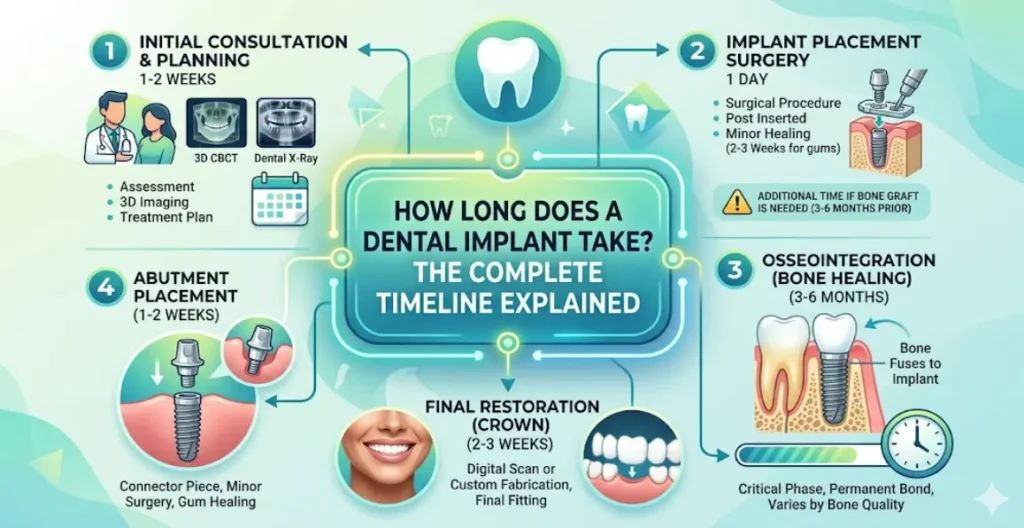
The Complete Dental Implant Process: Stage by Stage
Day 1
Consultation and 3D Imaging
A full assessment of your oral health, medical history, and a 3D CBCT scan of your jaw. The scan shows bone volume, density, nerve positions, and sinus proximity. Your complete treatment plan is mapped in this appointment. You leave knowing exactly what your case involves, how long it will take, and what it will cost. At Smilessence, this all happens at a single consultation.
If needed
Preparatory Treatment (if applicable): 1 to 6 months
Not every patient needs this stage. If you have active gum disease, it must be treated first. If you have insufficient bone volume, bone grafting is performed and given time to integrate before the implant goes in. Bone grafting adds 3 to 6 months before surgery. Gum treatment takes 4 to 8 weeks. If neither is needed, you move directly to implant surgery.
Surgery day
Implant Surgery: 60 to 120 minutes
The implant post, a precision-machined titanium screw, is placed into the jawbone under local anaesthesia. A small incision is made in the gum, the bone is prepared, and the implant is seated to precise depth. The gum is sutured. The surgery takes approximately 60 minutes for a single implant and 90 to 120 minutes for multiple implants. We use Astra Tech implants at Smilessence, a premium Swiss-designed system with a microscopically textured surface specifically engineered to accelerate bone cell attachment and osseointegration.
Days 1-7
Initial Healing: First Week
A blood clot forms at the surgical site, protecting the wound while healing begins. Swelling and mild discomfort peak at 48 to 72 hours then progressively reduce. Most patients manage this comfortably with standard over-the-counter pain relief. Soft foods, no smoking, and gentle oral hygiene are the key instructions. By day 5 to 7, most patients are back to normal daily activities.
Weeks 2-16
Osseointegration: 10 to 16 weeks
This is the most important stage of the entire process and the main reason implants take as long as they do. Osseointegration is the biological process in which new bone cells grow onto and around the titanium implant surface, fusing the implant to the jawbone at a microscopic level. There is nothing you feel during this stage. You go about your normal life. The lower jaw typically integrates in 10 to 14 weeks. The upper jaw takes slightly longer, 12 to 16 weeks, because upper jaw bone is naturally less dense. Regular check-ups at 4 and 8 weeks allow us to monitor progress.
Week 12-16
Abutment Placement: 2 to 3 weeks healing
Once osseointegration is confirmed by X-ray and stability testing, a small connector piece called an abutment is attached to the top of the implant. This minor procedure takes 20 to 30 minutes. In some cases, the abutment is placed at the same time as the implant, eliminating this as a separate visit. The gum tissue around the abutment heals over 2 to 3 weeks, shaping itself around the emerging connector.
Weeks 14-20
Crown Fabrication and Fitting: 2 to 3 weeks
Impressions or digital scans of your teeth are sent to a dental laboratory. Your custom crown is fabricated to match the exact shape, size, and shade of your surrounding teeth. Fabrication takes 2 to 3 weeks. Once ready, the crown is fitted to the abutment, your bite is checked and adjusted, and the implant is complete.
Done
Final Result: A permanent tooth
You now have a fully integrated implant with a custom crown that looks, feels, and functions like a natural tooth. No removal. No adhesives. No diet restrictions. Routine brushing, flossing, and annual check-ups are all that is needed to maintain it for life.
Full Timeline Summary: How Long Does the Whole Dental Implant Process Take?
| Case Type | Total Treatment Time | Key Factors |
|---|---|---|
| Simple single implant (no bone graft) | 3 to 6 months | Adequate bone, healthy gums, lower jaw site |
| Upper jaw single implant | 4 to 7 months | Slower osseointegration in less dense bone |
| With bone grafting | 9 to 15 months | Graft healing (3-6 months) before implant placement |
| With sinus lift (upper jaw) | 10 to 18 months | Sinus augmentation adds significant healing time |
| All-on-4 full arch | 3 to 6 months | Same-day temporary teeth on surgery day; permanent after healing |
| Same-day immediate loading | 1 day (temp) + 3-6 months (permanent) | Eligible patients only; requires high primary stability |
Why Does a Dental Implant Take So Long?
This is the most common source of frustration for patients, and it deserves a straight answer.
The time is not spent in the dental chair. You are not having multiple hours of treatment spread across months. The time is the biology. Osseointegration, the process of bone fusing with the titanium implant, cannot be rushed. It is a cellular process that happens at a rate dictated by your body’s bone remodelling cycle.
Here is what is happening inside your jaw during those 10 to 16 weeks:
- Days 1-14: A blood clot forms around the implant. Inflammatory cells clean the surgical site. Initial fibrous tissue begins forming between the implant and bone.
- Weeks 2-6: Osteoblasts (bone-forming cells) migrate to the implant surface and begin depositing new bone matrix directly onto the titanium. Immature bone tissue locks the implant in place.
- Weeks 6-16: Immature bone undergoes remodelling, gradually replaced by dense, mature bone. The implant’s stability increases week by week as this process completes.
- Beyond 16 weeks: Continued bone maturation. The bone-implant interface strengthens further over the first year after placement.
There is no medication or technique that meaningfully compresses this biological timeline. What premium implant systems like Astra Tech do is use surface textures that encourage faster initial bone cell attachment, which supports earlier stability. But the fundamental biology sets the pace, and that is what protects the long-term success of your implant.
Why you cannot rush osseointegration: Loading an implant with a crown before osseointegration is complete causes micro-movement at the bone-implant interface. This disrupts the forming bone, compromises integration, and can lead to implant failure. The wait is not bureaucracy. It is what makes implants last a lifetime.
What Affects Your Dental Implant Timeline?
Jaw location
Lower jaw bone is denser. Osseointegration completes in 10-14 weeks. Upper jaw takes 12-16 weeks. Upper molar sites near the sinus may need a sinus lift, adding 3-6 months.
Bone volume and density
Good, dense bone heals faster. Bone loss requires grafting first, adding months. Low-density bone may take longer to reach full integration. Assessed on 3D scan before treatment.
General health
Uncontrolled diabetes slows healing. Smoking reduces blood supply to healing tissue. Controlled conditions have minimal impact on the standard timeline.
Implant system
Premium systems like Astra Tech, which we use at Smilessence, have textured surfaces that promote earlier bone cell attachment compared to older smooth-surface designs.
Individual healing rate
Every patient’s bone remodelling cycle is slightly different. Readiness is confirmed through X-ray and stability testing before the crown appointment, not by fixed calendar dates alone.
Number of implants
Multiple implants placed in the same session do not add to the overall timeline as they all osseointegrate simultaneously. Only additional preparatory stages add time.
Can It Be Faster? Same-Day Dental Implants Explained
Yes, in carefully selected cases.
Same-day implants (immediate loading or “teeth in a day”) place the implant and a temporary crown in a single appointment. You arrive without a tooth and leave with one. This works only where specific conditions are met:
- Sufficient bone volume and density at the implant site
- No active infection or gum disease present
- The implant achieves high primary stability at placement
- The temporary crown does not carry heavy biting load during healing
For full arch cases, same-day treatment works particularly well. All-on-4 implants place four implants and a temporary full arch of teeth the same day. The final permanent teeth are delivered 3 to 6 months later once osseointegration is complete. Read the dedicated guide: same-day dental implant treatment.
The honest picture on “teeth in a day”: It is real and works beautifully for the right patient. But it requires 3D assessment first to confirm eligibility. A patient with significant bone loss, active gum disease, or insufficient primary stability cannot safely have immediate loading. Your scan confirms which category applies to you.
How Long Does a Dental Implant Last?
The other side of the time question that every patient should understand.
The implant post, the titanium root in your bone, is designed to last a lifetime. With proper care, implants placed in your 40s or 50s can still be functioning in your 70s and 80s. Published studies consistently report 95% or higher survival rates at 10 years. Longitudinal studies track patients with implants functioning well at 25 to 30 years post-placement.
The crown on top of the implant, the visible tooth, typically lasts 10 to 20 years before it may need replacement due to normal wear. Replacing the crown does not mean replacing the implant. The titanium post below remains fully integrated and intact.
What protects long-term implant survival:
- Daily oral hygiene: Brushing and flossing around the implant prevents peri-implantitis, the leading cause of late implant failure
- Regular check-ups: Annual visits allow early detection of any marginal bone loss before it becomes a problem
- Not smoking: Smoking accelerates bone loss around implants over time and is the single biggest preventable cause of late implant failure
- Night guard if needed: Teeth grinding (bruxism) stresses the crown and abutment over time. A night guard protects your investment during sleep
At Smilessence, Astra Tech implants carry a lifetime warranty on the implant post itself, reflecting both the quality of the system and the precision of placement. See full details on our dental implants in Gurgaon treatment page.
Frequently Asked Questions
How long does a dental implant take to get from start to finish?
For a standard single implant without preparatory work: 3 to 6 months from surgery to final crown. The surgery itself is 60 to 90 minutes. The remaining time is the osseointegration healing period. If bone grafting is required before the implant can be placed, total treatment time extends to 9 to 15 months. Same-day implants compress this significantly for eligible patients.
How long does the dental implant procedure itself take?
The placement surgery for a single implant takes approximately 60 to 90 minutes. Multiple implants placed in the same session take 90 to 180 minutes. The procedure is performed under local anaesthesia. Most patients describe it as more comfortable than anticipated. You leave the same day, typically with a temporary cover or temporary crown over the site.
How long does dental implant take to complete (total process)?
See the summary table above. The short version: 3 to 6 months for a straightforward case, 9 to 15 months if bone grafting is needed, up to 18 months if a sinus lift is required. All-on-4 full arch cases run 3 to 6 months with temporary teeth placed on surgery day itself.
Why does a dental implant take so long?
The time is the biology, not the dentistry. Osseointegration, bone growing around and fusing with the titanium implant, takes 10 to 16 weeks. This process is governed by your body’s bone remodelling cycle and cannot be meaningfully rushed. Placing a crown before osseointegration is complete risks micro-movement, which disrupts the forming bone and leads to implant failure. The wait is what makes implants the permanent solution they are.
How long does getting a tooth implant take if I need a bone graft?
Bone grafting adds approximately 3 to 6 months to the overall timeline. The graft is placed, allowed to fully integrate with your existing jaw bone, and then the implant is placed into the newly rebuilt bone. Total treatment from bone graft to final crown is typically 9 to 15 months. Read the complete guide: can I get dental implants with bone loss.
How long does a dental implant last?
The titanium implant post is designed to last a lifetime. Studies report 95%+ survival at 10 years and functioning implants at 25 to 30 years are well documented. The crown on top typically lasts 10 to 20 years before potential replacement due to wear. Replacing the crown does not require removing or replacing the implant post. See our dental implants cost in Gurgaon page for details including the Astra Tech lifetime warranty. Browse more guides on our dental blog.
How long after a tooth extraction can I get a dental implant?
In eligible cases, immediately at the same appointment as the extraction. Where the socket needs initial healing, 6 to 8 weeks. Where significant bone loss around the extracted tooth requires grafting, 3 to 6 months post-extraction. Your 3D scan at consultation determines which route is appropriate for your specific anatomy. Read more about the full implant procedure on our how an implant procedure works page.
Want to Know Your Exact Timeline? Find Out in One Appointment.
At Smilessence, your consultation includes an in-house 3D imaging assessment that maps your bone precisely and tells you exactly how long your specific case will take, what it will cost, and what each stage involves. No vague estimates. A clear plan from day one.
Call or WhatsApp: +91 9811 303 933 | +91 9811 334 633
SFF/102, Ansal Palam Triangle, Palam Vihar, Gurgaon 122017 | Mon to Sun, 9 AM to 8:30 PM
In This Article
- The Complete Dental Implant Process: Stage by Stage
- Preparatory Treatment (if applicable): 1 to 6 months
- Implant Surgery: 60 to 120 minutes
- Initial Healing: First Week
- Osseointegration: 10 to 16 weeks
- Abutment Placement: 2 to 3 weeks healing
- Crown Fabrication and Fitting: 2 to 3 weeks
- Final Result: A permanent tooth
- Full Timeline Summary: How Long Does the Whole Dental Implant Process Take?
- Why Does a Dental Implant Take So Long?
- What Affects Your Dental Implant Timeline?
- Jaw location
- Bone volume and density
- General health
- Implant system
- Individual healing rate
- Number of implants
- Can It Be Faster? Same-Day Dental Implants Explained
- How Long Does a Dental Implant Last?
- Frequently Asked Questions
Want to Fix Missing Teeth Today?
Book a clinical assessment. We identify the source and start treatment the same day.
Book at Smilessence The Specialist Dental Centre Gurgaon +91 9811 303 933