
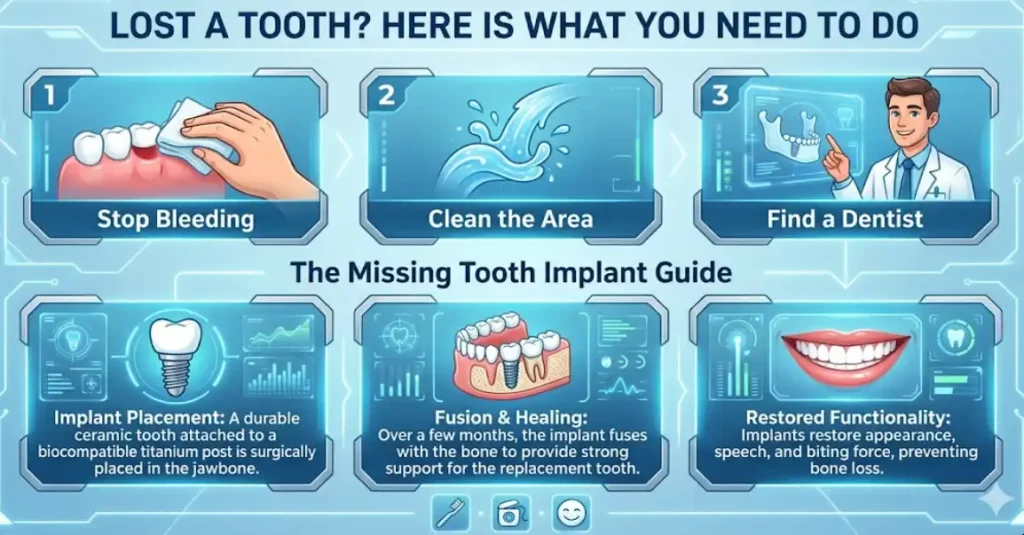
Whether you lost a tooth last week, last year, or a decade ago, this guide is for you.
Losing a tooth, whether from an accident, decay, gum disease, or an extraction, sets off a chain of events in your jaw that most people are completely unaware of. The gap in your smile is the visible part. What happens beneath the gum line is far more significant for your long-term health, your face shape, and the complexity and cost of fixing the problem.
The good news: replacing a single missing tooth is one of the most straightforward procedures in modern dentistry. A single tooth implant gives you back a tooth that looks, functions, and feels like the one you lost, without touching the adjacent teeth, without any removal, and without the limitations of a denture. It is also the only option that stops bone loss from progressing.
Let me walk you through what actually happens when you lose a tooth, your three replacement options, and why, for most patients, the implant is the right long-term answer.
What Happens to Your Jaw When You Lose a Tooth
Most people assume the damage from losing a tooth is cosmetic. A gap in the smile. Perhaps some difficulty chewing. They underestimate what is happening beneath the surface, and this misunderstanding is why so many people delay treatment longer than they should.
Your jawbone is kept dense and healthy by stimulation. Every time you bite and chew, forces travel through your tooth roots into the surrounding bone, triggering a constant cycle of bone cell regeneration. Remove a tooth and that stimulation disappears. The bone beneath the gap has no reason to maintain its density, so the body gradually resorbs it.
- 25%Bone width lost at the gap site within the first year of tooth loss
- 4mmAverage bone height reduction over 3 years without tooth replacement
- 11°Average tipping of adjacent teeth into gap over 2 years
Over time, the consequences compound:
- Adjacent teeth drift and tip into the gap, changing your bite and creating spaces where food traps and decay begins
- The opposing tooth super-erupts, growing downward (or upward) into the empty space, eventually losing stability itself
- The jawbone shrinks in width and height beneath the gap, making future implant placement progressively more complex and expensive
- The face begins to change as bone support is lost. Over years of multiple missing teeth, the characteristic sunken look of long-term denture wearers begins
The longer you wait, the harder and more expensive the fix becomes. A patient who replaces a tooth within 3 months of loss usually needs only a straightforward implant. A patient who waits 5 years may need bone grafting first, which adds months and significant cost to the process. Every month of delay after tooth loss is working against you.
Your Three Options for Replacing a Missing Tooth
Recommended for most patients
Option 1: Single Tooth Dental Implant
A titanium post is placed into the jawbone exactly where your natural root was. It fuses with the bone through osseointegration over 10 to 16 weeks. A custom crown is then fitted on top, matched perfectly to the size, shape, and shade of your surrounding teeth.
Why it is the best option:
- The only option that replaces the tooth root, not just the crown. This is what stops bone loss.
- Does not touch or alter the adjacent teeth in any way. They stay exactly as they are.
- Looks, feels, and functions like a natural tooth. You brush and floss normally.
- Lasts a lifetime with proper care. The titanium post is a permanent structure.
- Long-term cost is the lowest of all three options because it does not need replacement the way bridges and dentures do.
Timeline: 3 to 6 months for most patients. Same-day temporary tooth is possible in eligible cases.
Cost at Smilessence: Rs. 25,000 to Rs. 45,000 for a single implant including crown.
Acceptable if implant is not possible
Option 2: Dental Bridge
A bridge replaces the missing tooth by anchoring a false tooth (pontic) to the natural teeth on either side of the gap. Those adjacent teeth are filed down and crowned to support the bridge. The bridge is fixed and cannot be removed.
Why it is a compromise:
- Requires permanently grinding down two perfectly healthy adjacent teeth to act as pillars. This is irreversible.
- Does not replace the root. Bone loss beneath the gap continues after a bridge is placed.
- Requires special floss threaders to clean under the bridge. Hygiene is more complex.
- Lasts 10 to 15 years before typically needing replacement, at which point the compromised abutment teeth may also need attention.
- Is faster and less expensive upfront. No surgery required.
Best suited for: Patients who cannot have implant surgery for medical reasons, or where adjacent teeth already have significant existing restorations and would benefit from crowns regardless.
Cost: Rs. 15,000 to Rs. 35,000 for a three-unit bridge.
Temporary or last resort only
Option 3: Removable Partial Denture
A removable appliance with an artificial tooth that clips to surrounding teeth. The least expensive upfront option. Suitable as a temporary measure or where neither implant nor bridge is feasible.
The limitations:
- Removable. Has to come out for cleaning. Feels artificial and often uncomfortable.
- Provides no stimulation to the jawbone whatsoever. Bone loss continues and may accelerate.
- Can put stress on the teeth it clips to, potentially damaging them over time.
- For most patients with a single missing tooth, this is not a long-term solution.
Best suited for: As a temporary gap filler while planning for an implant, or for patients with very tight budgets who cannot commit to an implant at this time.
The full comparison: A detailed side-by-side breakdown of dental implants, bridges, and dentures across every factor (longevity, bone preservation, cost, chewing, hygiene) is in our complete guide: dental implants vs dentures vs bridge.
Why a Single Tooth Implant Is Different from a Bridge or Denture
The fundamental difference is what an implant replaces vs what a bridge or denture replaces.
A natural tooth has two parts: the crown (the visible part above the gum) and the root (the part embedded in the bone). When you lose a tooth, you lose both parts. A bridge replaces only the crown. A denture replaces only the crown. A dental implant replaces both.
That distinction matters enormously for the long-term health of your jaw. The root is what stimulates the bone. Without a replacement root, bone loss is inevitable regardless of what sits above the gum. An implant is the only tooth replacement that addresses the complete biological problem, not just the cosmetic one.
A bridge also creates a secondary problem that many patients do not discover until years later. To support the bridge, the two adjacent teeth must be ground down significantly and permanently. Even if those teeth were perfectly healthy before, they are now permanently altered. If the bridge eventually fails (typically after 10 to 15 years), those abutment teeth are now compromised and your options are more limited than they were when you started. The bridge solved one problem and created the conditions for two more.
Front Tooth vs Back Tooth: Does Location Matter?
Yes, but not in the way most patients assume.
Front teeth (incisors, canines)
Aesthetics are the primary concern. A missing front tooth is visible and affects confidence immediately. The good news: front tooth implants are often excellent candidates for same-day or early loading (a temporary crown placed the same day as surgery), which means you do not need to go through the healing period with a visible gap. Bone quality at the front of the jaw is generally good. The implant procedure for a front tooth is typically more straightforward than for a back tooth.
Back teeth (premolars, molars)
Many patients underestimate the consequences of a missing back tooth because it is not visible. But back teeth carry the majority of your chewing load. Losing a molar without replacing it shifts this load onto fewer teeth, causing accelerated wear and crack risk. The upper back teeth sit close to the sinus, which sometimes requires a sinus lift procedure if bone height is insufficient. Back tooth implants require the same planning as front teeth, but the timeline may be slightly longer in upper molar positions.
In both cases, the underlying principle is the same: replace the missing tooth as soon as possible to stop bone loss and prevent the surrounding teeth from shifting.
How Soon Can You Get an Implant After Losing a Tooth?
Sooner than most people expect.
In eligible cases, an implant can be placed at the same appointment as the tooth extraction. This is called an immediate implant. The socket is prepared, and the implant is placed directly into the fresh extraction site before the bone has any chance to resorb. Where the socket is clean, infection-free, and bone volume is adequate, this is an excellent approach that minimises total treatment time and preserves the maximum bone.
In other cases, a short healing period of 6 to 8 weeks after extraction allows the socket to stabilise before implant placement. Where significant bone loss or infection around the extracted tooth requires bone grafting, we wait 3 to 6 months post-extraction before placing the implant.
Your 3D imaging assessment at Smilessence determines which approach is appropriate for your specific socket and bone anatomy. Read the full timing guide in our article on how long dental implant treatment takes.
The Single Tooth Implant Process at Smilessence
Here is exactly what the process looks like for a standard single missing tooth implant at Smilessence:
- Consultation and 3D imaging: In-house CBCT scan maps your bone volume and density at the missing tooth site. We plan the implant position, angle, and depth digitally before surgery begins. You leave with a clear treatment plan and confirmed timeline.
- Implant surgery (60-90 minutes): Under local anaesthesia, a small incision is made, the bone is prepared, and the Astra Tech implant is placed to precise depth and position. The gum is sutured. You go home the same day.
- Osseointegration (10-16 weeks): The implant fuses to your jawbone. You live normally during this period. Check-ups at 4 and 8 weeks confirm healing progress.
- Crown fitting (2-3 weeks): A digital or physical impression is taken, your custom crown is fabricated, and fitted to the implant. Colour, shape, and size are matched to your surrounding teeth.
- Done: A permanent tooth that you brush and floss like a natural tooth, with no removal, no adhesives, and no dietary restrictions.
Cost of a Single Missing Tooth Implant
At Smilessence, a single tooth implant costs approximately Rs. 25,000 to Rs. 45,000 for the complete treatment, including the Astra Tech implant, abutment, and custom crown. The exact cost is confirmed at your consultation after the 3D imaging assessment, which determines whether any preparatory work such as bone grafting is needed.
Full cost details are available on our dental implants in Gurgaon treatment page.
For comparison:
| Option | Upfront Cost (India) | Expected Lifespan | Long-term Total Cost |
|---|---|---|---|
| Single tooth implant | Rs. 25,000 – Rs. 45,000 | Lifetime (post) / 10-20 yrs (crown) | Lowest long-term |
| Dental bridge (3 unit) | Rs. 15,000 – Rs. 35,000 | 10-15 years | Higher (needs replacement; adjacent teeth compromised) |
| Removable partial denture | Rs. 5,000 – Rs. 15,000 | 3-5 years | Highest over 20 years (frequent repairs/replacements) |
Frequently Asked Questions
I just lost a tooth. What should I do first?
Book a dental consultation as soon as possible, ideally within a few weeks of the loss. The sooner you are assessed, the more options you have, including immediate implant placement into the fresh socket. Every week of delay allows bone resorption to progress at the missing site. If the tooth was knocked out completely in an accident, see an emergency dentist immediately as reimplantation may be possible within hours if the tooth is handled correctly.
Can a single missing tooth really cause other teeth to shift?
Yes. Adjacent teeth gradually tip into a gap over months and years. The opposing tooth (the one that used to bite against the missing tooth) begins to super-erupt, growing further out of the bone to fill the lost contact. Both changes alter your bite, create new food trapping areas, and put unusual stress on surrounding teeth. These changes are slow but cumulative and become harder to reverse the longer the gap is left.
Is a dental implant better than a bridge for a single missing tooth?
For most patients with a single missing tooth and healthy adjacent teeth, yes. An implant preserves the adjacent teeth completely (no grinding), replaces the root to prevent bone loss, lasts longer, and has a lower long-term cost. A bridge may be appropriate where adjacent teeth already have significant restorations or where implant surgery is not medically feasible. Our blog post comparing dental implants vs dentures vs bridge covers every factor in detail.
How long does it take to get a single tooth implant?
Typically 3 to 6 months from surgery to final crown, including the osseointegration healing period. If bone grafting is needed first, total treatment extends to 9 to 12 months. In eligible cases, a temporary crown can be placed the same day as surgery. Read the complete timeline guide: how long does a dental implant take.
Does getting a single tooth implant hurt?
The surgery is performed under local anaesthesia. Most patients report that the procedure was significantly more comfortable than they anticipated, often less eventful than having a tooth extracted. Post-surgical discomfort for the first 2 to 3 days is typically manageable with standard over-the-counter pain relief. By day 5 to 7, most patients are back to normal activities with no ongoing discomfort.
What if I have had a missing tooth for several years? Is it too late for an implant?
It is rarely too late, but waiting does make things more complex. Long-term bone loss at the missing site may require bone grafting before the implant can be placed. However, bone grafting is a routine procedure at Smilessence and opens the door to implants for most patients who have been missing a tooth for years. A 3D scan assessment tells you exactly what your bone can support and what treatment is needed. See our detailed guide: can I get dental implants with bone loss. Browse more guides on our dental blog.
What is the cost of a single tooth implant in Gurgaon?
At Smilessence, a single tooth implant using Astra Tech implants costs approximately Rs. 25,000 to Rs. 45,000 complete, including the implant post, abutment, and custom crown. The exact cost is confirmed after your 3D imaging assessment. See full details on our dental implants cost in Gurgaon treatment page.
Missing a Tooth? Let’s Replace It Properly.
A single missing tooth is entirely solvable. Book a consultation with Prof. Dr. Vineet Vinayak at Smilessence. We will take a 3D scan, assess your bone, and give you a clear treatment plan and cost in one appointment.
No pressure. Just a clear picture of your best options.
Call or WhatsApp: +91 9811 303 933 | +91 9811 334 633
SFF/102, Ansal Palam Triangle, Palam Vihar, Gurgaon 122017 | Mon to Sun, 9 AM to 8:30 PM
In This Article
- What Happens to Your Jaw When You Lose a Tooth
- Over time, the consequences compound:
- Your Three Options for Replacing a Missing Tooth
- Recommended for most patients
- Option 1: Single Tooth Dental Implant
- Option 2: Dental Bridge
- Option 3: Removable Partial Denture
- Why a Single Tooth Implant Is Different from a Bridge or Denture
- Front Tooth vs Back Tooth: Does Location Matter?
- Front teeth (incisors, canines)
- Back teeth (premolars, molars)
- How Soon Can You Get an Implant After Losing a Tooth?
- The Single Tooth Implant Process at Smilessence
- Cost of a Single Missing Tooth Implant
- Frequently Asked Questions
Want to Fix Missing Teeth Today?
Book a clinical assessment. We identify the source and start treatment the same day.
Book at Smilessence The Specialist Dental Centre Gurgaon +91 9811 303 933