
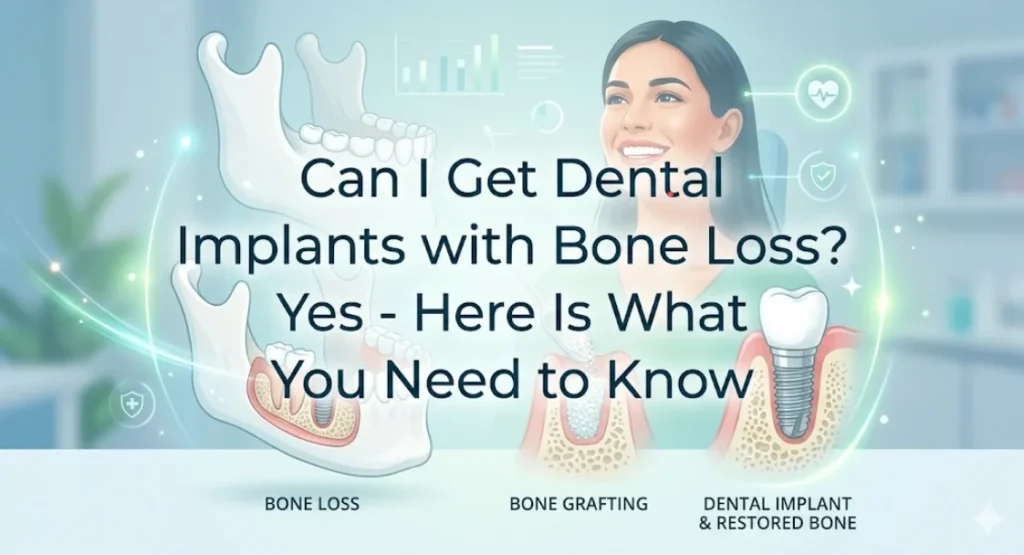
Yes. In the vast majority of cases, you can still get dental implants even if you have bone loss.
That is the most important thing I want you to take from this article. The assumption that bone loss automatically rules out implants is one of the most common and most damaging misconceptions in dentistry. I have personally treated hundreds of patients in Gurgaon who were told by a previous dentist that their bone loss made implants impossible. For most of them, it was not impossible. It required more planning, and sometimes a preparatory procedure, but it was entirely achievable.
What bone loss does is change the route to your implant, not necessarily close the door on it. The solution that is right for you depends on how much bone you have lost, where it has been lost, and what caused it. This guide walks you through all of it.
Why Does Bone Loss Happen?
Understanding the cause matters because some causes need to be treated before any implant work can begin.
Your jawbone stays dense and healthy because of stimulation. Every time you bite and chew, forces travel through your teeth into the bone, triggering a constant cycle of bone cell regeneration. Remove a tooth, and that stimulation disappears. The bone beneath the gap has no reason to maintain its density, so the body gradually resorbs it. This process starts within weeks of tooth loss and continues for years.
The most common causes of jawbone loss in India are:
- Missing teeth left unreplaced: The longer a gap sits without a replacement tooth root, the more bone is lost beneath it. This is the single most common cause I see.
- Long-term denture use: Traditional removable dentures sit on the gums. They do not replace the tooth root, so they provide no stimulation to the bone. Years of wearing dentures accelerates bone resorption and changes the shape of the jaw.
- Gum disease (periodontitis): Advanced gum disease destroys both the soft tissue and the bone that support your teeth. It is one of the leading causes of tooth loss and associated bone loss in India.
- Tooth extraction without timely replacement: Every extracted tooth that is not replaced begins the bone loss process immediately.
- Trauma or injury: A blow to the jaw can damage bone directly. Road accidents are a significant cause of dental bone loss in India.
A number worth knowing: Research shows that within the first year after tooth loss, you can lose up to 25% of the bone width at that site. After three years, bone volume loss can reach 40 to 60%. This is why getting a proper tooth replacement promptly matters so much.
How Much Bone Do You Need for a Dental Implant?
A standard dental implant typically needs at least 1 to 2mm of bone surrounding it on all sides for stable long-term integration. In practical terms, this generally means a minimum of about 5 to 6mm of bone height and 6mm of bone width at the implant site.
If you are below these minimums, it does not mean you cannot have an implant. It means your treatment plan needs an additional step. Let me break this down by severity.
Solutions for Bone Loss – Matched to Severity
Mild Bone Loss
What it looks like: You have a missing tooth or teeth, some reduction in bone volume, but still adequate density and width for standard implant placement. This is often the case when teeth have not been missing for very long.
Solution: Standard dental implants can often be placed directly, sometimes with a minor bone augmentation done at the same time as implant surgery. No separate grafting procedure is needed.
Timeline: Standard implant timeline. Osseointegration takes 10 to 16 weeks before the final crown is fitted.
Moderate Bone Loss
What it looks like: Bone has shrunk significantly at the site. You may have had missing teeth for several years, worn dentures, or had gum disease. There is not enough bone to place an implant directly, but the remaining bone is sound.
Solution: Bone grafting. Bone graft material is placed into the deficient area to stimulate new bone growth. The graft integrates with the existing jaw over 3 to 6 months. Once sufficient bone has regenerated, implants are placed into the new bone. The bone graft material can come from your own body, a donor source, or a high-quality synthetic material.
Timeline: Bone graft healing adds 3 to 6 months before implant placement. Total treatment is longer but the final result is a fully stable implant supported by solid bone.
Cost in India: Bone grafting in Gurgaon typically costs between Rs. 10,000 and Rs. 30,000 per site, depending on the volume of graft material needed. This is in addition to the implant cost.
Severe Bone Loss
What it looks like: Extensive bone has been lost over many years. The jaw may appear shrunken or the face may look sunken due to loss of bone support. This is common in long-term denture wearers and patients with advanced untreated gum disease.
Solutions available (one or more may apply):
- All-on-4 implants: Specifically designed for patients with bone loss, particularly at the back of the jaw. Four implants are placed at strategic angles to anchor into the denser bone that remains at the front of the jaw. This technique frequently avoids the need for bone grafting even in cases of significant bone loss. It is one of the most powerful tools we have at dental implant treatment in Gurgaon for patients who have been told their bone loss rules out implants.
- All-on-6 implants: Uses six strategically placed implants for greater stability, particularly in the upper jaw where bone density is naturally lower. All-on-6 is especially recommended for full upper arch restoration with bone loss.
- Sinus lift (for upper jaw): When bone loss in the upper jaw has caused the sinus floor to drop too close to the jaw surface, a sinus lift procedure raises the sinus membrane and places graft material beneath it, creating height for implant placement. This is a routine procedure at specialist implant centres.
- Ridge augmentation: Rebuilds the width of a narrow or flat ridge to create adequate bone for standard implants.
- Implant-supported dentures: Where individual implants are not feasible due to extensive bone loss throughout the jaw, a small number of implants can anchor a denture securely. This gives far better stability than a conventional removable denture.
Timeline: Varies significantly by chosen approach. All-on-4 can often be completed with same-day temporary teeth. Bone grafting routes take 6 to 12 months total. Your 3D imaging assessment will confirm which route applies to your specific anatomy.
Can You Get Implants with Bone Loss in India?
The answer is the same as anywhere in the world: yes, with the right specialist and the right technology. What is different in India is that bone loss from long-term denture use and untreated gum disease is extremely prevalent, which means experienced implant centres like Smilessence manage these cases routinely.
India also offers a significant cost advantage for the more complex preparatory procedures. Bone grafting in India costs a fraction of what the same procedure costs in the UK, USA, or UAE, which means the total cost of implant treatment including preparatory procedures is still dramatically lower than getting the same treatment abroad.
Many NRI patients specifically time their India visits to complete both their bone grafting and implant procedures here, taking advantage of the quality-to-cost ratio that Indian specialist implant centres provide. You can read about planning that kind of treatment visit in our dental health blog.
Can You Get Denture Implants with Bone Loss?
Yes. This is one of the most common situations we treat.
Many patients who have worn dentures for years come to us after their dentures have become progressively looser and less functional. Years of denture use has caused significant bone loss, and they worry they have missed their chance at implants entirely.
The good news: implant-supported dentures can stabilise an existing denture using just two to four implants, even in patients with considerably reduced bone. The implants anchor into whatever bone remains, and the denture clips onto them. The result is a denture that does not move, does not require adhesive, and does not restrict your diet.
For patients with more severe bone loss who want a fully fixed solution, All-on-4 is often the answer. The angled implant placement technique was specifically engineered for patients in this situation.
Can You Get Implants with 50% Bone Loss?
50% bone loss is a clinically significant number but it does not automatically mean implants are off the table. Here is the nuance:
50% bone loss around a natural tooth often signals advanced periodontitis and means that tooth is at risk of being lost. But 50% bone loss at an extraction site or from long-term tooth absence is a different context. What matters is not just the percentage but the absolute volume of bone remaining, where it is located, and its density.
A patient with 50% bone loss at a single molar site who has good bone at the front of the jaw may still be an excellent All-on-4 candidate. A patient with 50% generalised bone loss throughout the jaw requires a more detailed 3D assessment before any plan can be made.
The only accurate answer to “can I get implants with 50% bone loss?” is: it depends on the 3D scan. A percentage figure without imaging data tells us relatively little. What I can tell you is that I have treated patients with extensive bone loss who went on to have completely successful implant treatment through the right combination of techniques.
The risk of waiting: Bone loss is progressive. The longer a gap sits without a tooth root, the more bone continues to be lost. A patient who is a borderline candidate for standard implants today may need more complex treatment in two years’ time. If you have bone loss and are considering implants, the cost of waiting is almost always higher than the cost of acting now.
The Role of 3D Imaging in Bone Loss Cases
This is worth its own section because it is critical to understanding what is actually possible in your specific case.
A conventional X-ray shows bone in two dimensions. It gives a general sense of bone height but tells you nothing about width, density, or the precise anatomy of the jaw in three dimensions. Planning an implant case with bone loss from a conventional X-ray alone is like navigating a city using only a flat map with no street-level detail.
A CBCT (Cone Beam CT) 3D scan shows everything. Bone height, bone width, bone density, the position of nerves and sinuses, and the exact location of any remaining bone that can support an implant. This is the technology we use at Smilessence for every complex bone loss case. Without a 3D scan, nobody can tell you with certainty what is and is not possible in your jaw.
This is also why “you cannot get implants because of bone loss” is rarely a definitive verdict when given without 3D imaging. It may be an accurate assessment. But without the scan, it is not a complete one.
Gum Disease and Bone Loss: Treat the Cause First
If your bone loss is caused by active gum disease, the gum disease must be treated and brought under control before any implant work can begin. Placing an implant into infected tissue or around active infection is one of the leading causes of implant failure.
At Smilessence, gum disease treatment comes first in any case where active periodontitis is present. Our gum treatment programme includes deep cleaning, root planing, and where necessary laser treatment or surgical intervention. Only once the infection is resolved and the tissue is stable do we move to implant planning.
The good news: treating your gum disease also stops further bone loss. So getting your gums healthy protects whatever bone you have left and sets you up for a more successful implant outcome.
Frequently Asked Questions
Can I get dental implants with bone loss in India?
Yes. Bone loss is extremely common among patients seeking implants in India due to high rates of long-term denture use and untreated gum disease. Specialist implant centres like Smilessence handle these cases every week using bone grafting, All-on-4, sinus lift procedures, and implant-supported dentures. The combination of specialist expertise and India’s cost advantage makes high-quality treatment for complex bone loss cases very accessible.
Can I still get dental implants if I have had bone loss for many years?
In most cases, yes. Long-term bone loss does reduce your options for standard implant placement but it rarely eliminates all options. All-on-4 implants were specifically designed for patients with years of bone loss from denture use or tooth absence. A 3D imaging assessment is the only way to determine exactly what is possible for your specific jaw anatomy.
Can I get dental implants with severe bone loss?
Often yes. Severe bone loss requires advanced solutions rather than standard implants. All-on-4 uses angled implants to access denser bone at the front of the jaw. Zygomatic implants anchor into the cheekbone entirely for extreme upper jaw bone loss cases. Bone grafting with a subsequent implant placement is another route. The right solution depends on where the severe bone loss is located and which bone remains. A specialist assessment with 3D imaging is essential.
Can you get denture implants with bone loss?
Yes. Implant-supported dentures are specifically designed for situations where full individual implants may not be feasible due to bone loss. As few as two or four implants can anchor a denture securely, making it fixed and stable without requiring extensive bone for each individual implant. For patients who want fully fixed permanent teeth rather than a denture, All-on-4 is often the better route if bone loss is significant.
Can you get implants with 50% bone loss?
It depends on the type and location of the bone loss, not just the percentage. 50% bone loss at specific sites with remaining solid bone elsewhere in the jaw often still allows for implant treatment using angled or strategic placement techniques like All-on-4. 50% generalised bone loss throughout the jaw requires a full 3D assessment to determine the right approach. The percentage alone does not answer the question. Only imaging data does. See full details on our dental implants in Gurgaon treatment page.
How long does bone grafting take before I can get implants?
Bone grafting typically requires 3 to 6 months of healing time before the graft has integrated sufficiently for implant placement. The exact timeline depends on the volume of graft material placed and your individual healing rate. Some minor grafting procedures can be done simultaneously with implant placement, shortening the overall treatment time. Your treatment plan will specify the expected timeline for your case.
What is the cost of bone grafting for dental implants in India?
Bone grafting in Gurgaon typically costs between Rs. 10,000 and Rs. 30,000 per site depending on the size of the area being treated and the type of graft material used. This is significantly lower than the equivalent procedure in the UK (GBP 500 to 1,500 per site) or the USA (USD 700 to 3,000 per site). For a personalised cost estimate that includes any preparatory procedures needed in your case, contact us with your latest X-rays or dental records.
How do I find out if my bone loss rules out implants?
A 3D CBCT scan and consultation with an MDS implantologist. There is no other reliable way. At Smilessence, we conduct in-house 3D imaging as part of your first consultation. Within one appointment, we can show you exactly what your bone looks like in three dimensions, which options are available for your specific anatomy, and what the full treatment plan and cost would be. Read about who qualifies for implants in our related guide: who is a candidate for dental implants.
Been Told Bone Loss Rules Out Your Implants? Get a Second Opinion.
Book a consultation with Prof. Dr. Vineet Vinayak at Smilessence. We use in-house 3D digital imaging to assess your exact bone volume and map every available treatment route for your specific anatomy.
If implants are possible for you, we will show you exactly how. If they are genuinely not the right option, we will tell you that too – honestly.
Call or WhatsApp: +91 9811 303 933 | +91 9811 334 633
SFF/102, Ansal Palam Triangle, Palam Vihar, Gurgaon 122017 | Mon to Sun, 9 AM to 8:30 PM
In This Article
- Why Does Bone Loss Happen?
- How Much Bone Do You Need for a Dental Implant?
- Solutions for Bone Loss – Matched to Severity
- Mild Bone Loss
- Moderate Bone Loss
- Severe Bone Loss
- Can You Get Implants with Bone Loss in India?
- Can You Get Denture Implants with Bone Loss?
- Can You Get Implants with 50% Bone Loss?
- The Role of 3D Imaging in Bone Loss Cases
- Gum Disease and Bone Loss: Treat the Cause First
- Frequently Asked Questions
Want to Fix Missing Teeth Today?
Book a clinical assessment. We identify the source and start treatment the same day.
Book at Smilessence The Specialist Dental Centre Gurgaon +91 9811 303 933